
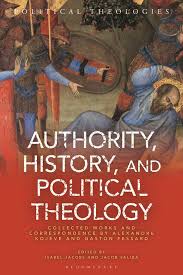
Bloomsbury Academic, London, 2026. 240 pp., £59.50 hb
ISBN 9781350476349
Reviewed by Matt McManus
Alexandre Kojève is one of the more mercurial figures in the history of continental thought. Born in the Russian empire in 1902, Kojève initially supported the Bolshevik Revolution – but not quite enough to stick around during its difficult birth. He transplanted to France, delivering a series of lectures on Hegel’s Phenomenology of Spirit that impressed everyone who heard them. The shattering effects of the Second World War eventually moderated Kojève into supporting the pacifism promised by European integration, and he continued to publish on a variety of topics while working as a civil servant. Today he is probably best known for the legion of figures his idiosyncratic reading of Hegel influenced, from radicals like Merleau-Ponty to moderates such as Francis Fukuyama. His aptitude for creative interpretation remains intriguing even if very few now ought take on board Kojève’s optimistic reading of Hegel as envisioning an ‘end of history’, where spirit could finally rest after its millennium-long journey.
Most aspects of Kojève’s legacy, from his influence on the left to his dialogue with the important right-of-center philosopher Leo Strauss, have been thoroughly explored. In their welcome recent book Authority, History and Political Theology, editors Isabel Jacobs and Jacob Saliba explore a different dimension of Kojève’s thought: the religious. This was of course of great importance to Hegel himself, and the editors insists Kojève as well. As they note in their introduction:
The dialectical play between Hegelian science and Christian revelation, wisdom and religion, philosophy and theology, was central to the Hegel lectures. At stake for Kojève was an atheistic and anthropological reading of Hegel, one that immanentizes all eschatology, asserting that the end of time has been realized on earth, here-and-now. Hegel’s system of knowledge, for Kojève, was a philosophy without God, marking the end of Christianity in atheism. (5)
Jacobs and Saliba explore these themes by acquainting readers to the decades long dialogue between Kojève and the left of center Catholic philosopher Gaston Fessard. Little known to secular scholars, Fessard pioneered the reading of Hegel for Catholic purposes – most notably through his important work The Dialectic of the Spiritual Exercises of St. Ignatius of Loyola. One of the great merits of Jacobs and Saliba’s volume will likely be to introduce many readers to Fessard for the first time.
Like many, Fessard was struck by the originality of Kojève’s reading of Hegel, comparing it favorably to Hyppolite’s equally famous but more rigidly scholarly Genesis and Structure of Hegel’s Phenomenology of Spirit. For Fessard, Hyppolite’s reading was a ‘“good scholarly work.” Both its excellence and its limits are better qualified by adding the word “very” to the word good.’ By contrast, Fessard acknowledged that Kojève’s reading of Hegel was anything but faithful, drawing heavily on Marx and Heidegger amongst others. But this very willingness to creatively rework Hegel to explicate his deeper truths more clearly displayed Kojève’s passion ‘concerning the relationship between history and truth.’ (68) However, as a true believer, Fessard was very keen to rebut Kojève’s efforts to read Hegel as an atheist thinker. He was eager to retain a dimension of transcendence in the Hegelian dialectic.
On Kojève’s reading, Hegel was fundamentally an atheistic thinker because he firmly accomplished the de-transcendentalization of reality. A dimension of the Phenomenology of Spirit is humankind initially projecting a divine source of values that exists not only outside itself, but in the world as a whole. Gradually over time, humankind became increasingly self-conscious that in fact the source of values was always Spirit itself. Christianity represented this symbolically in an important way, which is one of the reasons Hegel retained respect for it. In Christianity, God descends into the profane world, becomes human and then dies on the Cross for the sake of his creation. On Kojève’s reading, Hegel took this Christian innovation to mythologically symbolize the maturing realization that God was from the beginning, and now nearing the end of the historical process, humankind. Hegel’s own philosophy gained its importance through being the first to explain this historical process in detail. In his review essay ‘Hegel, Marx, and Christianity’ – included in the volume – Kojève describes how ‘through Hegelian Science human reality becomes fully self-conscious. It therefore understands itself and reveals itself as it is in reality, which is to say, as essentially finite and mortal, since it was created, in the beginning, in and through an actual risk of life at the time of the “first” fight for recognition. In knowing itself to be mortal, it knows itself to live in a world without a beyond (Jenseits) or without God.’ (53)
This is of course a very idiosyncratic and intriguing reading of Hegel that suggests Kojève was a precursor to other Hegelian ‘Christian atheists’ like Slavoj Zizek. But it is by no means widely accepted. Despite his great respect for Kojève’s interpretative prowess, throughout Authority, History, and Political Theology one sees Fessard push back. He insists that ‘subjectively, it seems that Hegel remained truly a believer and a speculative religious mystic. Speaking of the relationship between faith and the historical community, he declared “We Lutherans-I am one and intend to remain so-have only that original faith.”’ (121) Fessard reads Hegel not as an atheist, but instead offering a philosophy of history that is fundamentally a theodicy (191). Through humankind becoming more self-conscious of its own nature, we in turn come to see the providence of God at work in the world and align ourselves more with it in an edifying way. On this reading, the freedom offered by Hegelian self-determination seems to entail willingly reconciling one’s self to God’s plan to the point where there is no more meta-ethical ambivalence about what is required of us, and no more Augustinian weakness of the will that limits our ability to fulfill our duty.
Jacobs and Saliba have rendered a considerable service by acquainting readers with this probing debate. On the key question of the proper interpretation of Hegel, I found myself echoing sentiments that were ironically similar to Fessard’s. His religious interpretation of Hegelianism seemed to me the more strictly accurate of the two. Hegel’s writings are saturated with religious language, and reading him as offering a providentialist theodicy seems truer to what he himself argued. But it isn’t clear that staying faithful to the truths in Hegelianism requires being strictly faithful to what Hegel himself ‘subjectively’ believed. I found myself leaning towards Kojève’s pioneering left-Hegelian interpretation of the Phenomenology of Spirit and staying truer to the spirit of Hegel’s interpretation of World Spirit. In his Lectures on the Philosophy of Religion, Hegel interpreted the myth of Genesis as a story not about the fall of man into death and decay, but rather its partial ascendance to being like God in knowing good and evil and having the freedom to choose between them. This came with many burdens, but enabled humankind to become active, subjective participants in the act of recreating creation itself. Such a humanistic interpretation of a religious lesson speaks to the strong pull of a minimum secularism Hegel himself seems to have felt, and Kojève doesn’t seem wrong in just giving the system one final little push.
On a more speculative note, Fessard’s Hegelianism was distinctly left-Christian. His theological interpretation of the philosophy of history required true believers to adopt a more sympathetic attitude towards liberalism and socialism as being in line with God’s providential plans for his creation. These sentiments were not just theoretical; that Fessard was appalled by the rise of Nazism and felt an alliance with the left might be the only route forward to preserve what was authentic in any Christianity that didn’t rot into clerical fascism.
Given their expertise it would be of great interest were Jacobs and Saliba to put these themes into conversation with the traditions of liberal and liberation theology in a future work. The very existentially stamped dialectic developed by Fessard reminds one a great deal of the theology of the great Christian socialist Paul Tillich. The Tillichean idea of God as not purely a transcendent out there, but the ground of Being to which we direct our highest concern, seemed to capture in theology many of the motifs Fessard tried to develop through reworking the philosophy of history. This could also be of great interest today given the similarities of the historical moment. Fessard and Tillich were both eager to find philosophical resources to justify a conciliation between Christianity and the left at a time where both were physically and spiritually threatened by an ascendant fascism and its various clerical collaborators. A more comprehensive work that contrasted the dialectical themes traced in Authority, History and Political Theology with other versions of Christian leftism might be very helpful in a time where right-wing Christian nationalism and populism are once more gaining ground.
28 September 2026

This review is licensed under the Creative Commons Attribution-NonCommercial-NoDerivs 3.0 Unported License
Comment on this review
No comments
View comments