
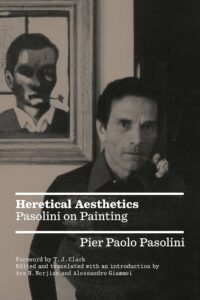
Foreword by T.J. Clark, Ara H. Merjian and Alessandro Giammei (eds. and trans.), Verso Books, London and New York, 2023. 224 pp., £13.59 pb
ISBN 9781804291283
Reviewed by Daniel Jackson
The critical, artistic and political career of Pier Paolo Pasolini centres on the search for and preservation of an ‘outside’ to bourgeois culture, from his earliest activist work to preserve the Friulian dialect to his final film, Salò or the 120 Days of Sodom. Heretical Aesthetics: Pasolini on Painting offers a constellatory glance at Pasolini’s career from 1942 to 1975, and a refraction of his most prominent ideas through his lifelong engagement with visual art. The publication comprises previously untranslated or uncollected essays and poems by Pasolini, translated by Ara H. Merjian and Alessandro Giammei, who also provide a detailed introduction and extensive commentary throughout. In their words, the writings that form the book depict ‘an erratic oscillation among para-academic contributions, careful studies of […] some rather obscure painters, and a few grandiose takes on some of the more visible events in the art world’ (21).
Merjian and Giammei’s introduction to the collection ‘A Force of the Past’ is a masterful articulation of the book’s stakes in light of Pasolini’s life, broader project and the scholarship surrounding it. They place this work alongside the well-known collection Heretical Empiricism as two images of ‘what it meant to self-identify as a Marxist intellectual in Italy during the Cold War’ (2). For Pasolini, this meant reckoning with the relationship between the rising quality of life for the general population following the postwar economic boom and the steady dissolution of any binding proletarian (at times interchangeable with ‘traditional’) culture and lifestyle. Against this dissolution, Pasolini conceived of an appropriate revolutionary activity as one that yearned not for a future classless society but for ‘an age that pre-dated class itself’ (4-5). In his earliest works, his focus is on the study and proliferation of dialect as a linguistic, artistic and activist practice (9). The years following his move from Friuli to Rome focus instead on figuration, faciality and the criminal activity of the city’s ‘lumpenproletariat’ (123-124). In the years leading up to and during the sexual revolution of the late 1960s, Pasolini shifts his attention to the sexual activity and bodies of historical people, represented in his ‘Trilogy of Life’ (Pasolini 2005: xvii-xviii). In his final years, he overturns all of these notions in the deeply pessimistic and searing critique of consumer culture, Salò (41-42). Merjian and Giammei’s contributions gracefully trace this development, becoming more than supplementary material. Given the lack of context for almost all of the pieces in the text, their introduction and commentary prove indispensable.
In Heretical Aesthetics, the writings that precede his debut feature Accatone (the first half of the book) are not immediately insightful. They are enmeshed in the minor art world of the postwar Friulian avant-garde, from which much has been lost, yet they are not dismissible as mere juvenilia. His concern with dialect in this period stemmed from anti-fascist practice under the regime, whose prerogative was the homogenisation of a national Italian language (Rohdie 1995: 117). ‘Dialect’, however, appears to become synonymous with any marginal or ‘peripheral’ phenomena, that is, outside of the geographical bourgeois centres of Italy (80). In ‘Dialectal Painting’ (1954), Pasolini ‘identifies a further, pictorial dimension to dialect’ in its potential as something ‘peripheral’ to the bourgeois ‘centralised painting of Milan-Florence-Rome’ which Pasolini associates with an innocence reminiscent of a ‘precapitalist archaic’ culture (80-82; Pasolini 1982: 117). There are notable glimpses of Pasolini’s more substantial thought in some of these early essays, such as four essays from 1955 on the painters Giuseppe Zigaina, Toti Scialoja, Fabio Mauri and Renzo Vespignani (85-98). The painters he discusses as ‘dialectal’ ‘indeed occupy a regional space’ that is decentred from the bourgeois artworld in both content and tone (81-82), but throughout he observes a tension between the artist’s revolutionary desire to capture an authentic image of the proletariat as an aesthetic object and the artist’s education, which is a product of the centralised bourgeois artistic education. The portions on this topic contain some of the earliest examples of his preferred pathological lexicon, with references to the ‘contamination’ of these works by bourgeois culture, ‘anterior to the artist’s own intentions’ (Pasolini et al. 2023: 97, 93).
Accattone can be marked as a turning point in Pasolini’s thought, as by that point his concern with dialect was marred by the fact that, for him, language altogether had been ‘rendered aridly inexpressive by its ever more technocratic and mediatic applications’ in the lead-up to the economic boom (7). Merjian and Giammei note the significance of this as a turning point for the poet turned filmmaker:
Only in the pre- or post-discursive lay for him the means of escaping bourgeois language and the soulless ‘communicability’ to which it condemned Italy’s citizens. It was in the periodically speechless realm of cinema that his poetics would take refuge, just as it would later seek out spaces and bodies ostensibly unspoiled by the inexorable spread of Western industry. (8)
As Pasolini’s critical interest in fine art wanes (20), his own aesthetic sensibility sharpens. In ‘Venting about Mamma Roma’, he argues that the intellectual and artistic ‘incompetence’ underlying criticism of his film stems from a ‘widespread conformism and cynicism’ that is, in fact, necessary for the ‘average commercial production’ of ‘our arid neocapitalism’. The ‘auterist cinema’ which Pasolini and his contemporaries produce, then, emerges from a ‘strong sense of cultural necessity’, in an attempt to escape the market in search of a visual poetics (120-123).
In ‘Technical Confessions’, Pasolini details the technical means by which he attempts to achieve this extra-verbal sense of alterity, once calling it ‘peripheral’ or ‘dialectal’ and now calling it ‘sacred’. With Accattone and Mamma Roma, it is the use of ‘lenses strictly between 50 and 70 mm-lenses which thicken matter, exalt three-dimensionality and chiaroscuro, lend weight and even the coarseness of worm-eaten food or soft stone to bodies’ (125-126). These techniques had to be altered in the representation of religious imagery in The Gospel According to St Matthew so as not to appear ‘rhetorical and obvious’, as though creating a ‘replica’ (127). The balancing act lies in representing the sacred, found ‘only superficially’ in the content of the film, and emphasising rather ‘the very mode of seeing the world, in the technical sacrality of seeing itself’ (125-128); that is to say, the artistic means by which the ‘ordinary’ or even ‘squalid’ can be imbued with a sense of sacredness.
This idea extends to the 1974 essay ‘Caravaggio’s Light’. Pasolini notes the impact of Caravaggio’s invention of a ‘new world’ revealed in his subjects, people previously ignored and ‘marginalised’ in the field of painting by a certain ‘cultural ideology’ (178). Caravaggio painted a ‘religious domain that encompassed the social’, depicting lumpen peasants in traditional religious scenes, to the dismay of conservative critics (Thomas, 2016: 120, 119). Merjian and Giammei note that Pasolini and Caravaggio share ‘an eye for the unlikely sacrality of the squalid and coarse; a penchant for boorishness to the point of blasphemy’ (180). Nowhere is this influence more evident than in Pasolini’s neorealist films, where he directly draws on Caravaggio (121). Pasolini designates this Caravaggian world as ‘profilmic’, as though already taking place in front of the camera, a technical mode of seeing. The second invention of the painter is a ‘new light’ which, rather than the ‘platonic’ all-encompassing light of previous religious paintings, is ‘quotidian’. Yet it is still ‘an artificial light proper solely to painting’ (178-179) – it represents a mode of seeing and representing that finds sacrality in the local, and yet is grounded in a specifically technical or artistic expression.
The latter half of the 1960s would have an indelible impact on Pasolini, as he experienced both the radical anti-Oedipal student movement and the consumerist revolution, which, for him, coalesced around the slogans of May 1968 around ‘enjoyment without obstacles’. If the student movement called for the abolition of the taboos of pleasure, the market happily sold the idea of the transgression, and so the centralised bourgeois culture bestowed a ‘vast (but false) tolerance’ which would come to engulf modern life. The ‘degeneration’ of life and bodies into consumer objects pushed Pasolini to search for his ‘outside’ elsewhere than in modern life altogether (Pasolini 2005: xviii-xix). Those ‘spaces and bodies unspoiled by the inexorable spread of Western industry’ would be located in the sexed bodies of the past (xviii). Pasolini’s ‘Trilogy of Life’, his adaptations of medieval literature to film, portrays the ‘outside’ or ‘sacred’ in the sex lives of its historical characters, free from the modern neurotic injunction to treat sex as a consumer object (Pasolini 1982: 119-120). Leading up to this period, Pasolini seems to find solidarity in the work of Romanino. Clark, in his foreword, notes the piece ‘The Art of Romanino and Our Time’ as ‘central’ to Pasolini’s aesthetic project for its clear autobiographical significance (xi-xii). This camaraderie is seen not only in Romanino’s refrain from ‘classicising’ or ‘formal austerity’, but also in the presence of ‘psycho-physical character portraits’ in his works, which would become a centrepiece of the aesthetic thought behind the ‘Trilogy of Life’ (132-134).
During this period of his cinematic work and late in Heretical Aesthetics, the book begins to discuss contemporary artworks as reflections of the modern deterioration of life and culture. Aligned with the ‘bourgeois’ and ‘irrational’ student protestors, these artists present form and figuration with total frivolity and emptiness, representing the gangrenous symptoms of a terminal societal ill, unlike artists such as Caravaggio and Romanino whom Pasolini praises (157, 160). In the ‘lamentably’ titled ‘The Mongoloide at the Biennale is a Product of Italy’s Subculture’, Pasolini argues that the “internal [consumerist] revolution” (159, 156), which has so quickly begun to destroy modern life, has been aided by the ‘thuggish servants of the neoavantguardia literati’ (156). Much like the (at the time) radical physical expression of the revolutionary youth and students – long hair being one of Pasolini’s major examples (Pasolini 1975: 3) – the artistic expression of the neo-avant-garde represents only a formal revolution or transgression. The example Pasolini takes in the piece is the display of a man with down syndrome as an artwork at the 1972 Venice Biennale by Gino De Dominicis. His judgement is that the piece, as an artwork, is vacuous, formalistic and ‘ideologically indifferent’ (158).
Shortly after the release of the final film in the Trilogy, Pasolini, increasingly pessimistic, would declare his ‘abjuration’ of that project and begin the production of Salò or the 120 Days of Sodom. This film marks the height of Pasolini’s pessimism, his rejection of Marxist orthodoxy and his disavowal of the contemporary avant-garde. ‘Lining the walls’ of Salò’s ‘infernal manor are the most exquisite expressions of late Western experimentalism […] witnesses to the horror from within the sidereal silence of their framed inhuman beauty’. Merjian and Giammei emphasise that the tension exposed is between ‘the violent sexual transgressions in the rooms and the supposedly revolutionary aesthetic transgressions on the wall’ (42). The failure of the revolutionary avant-garde to be in any sense meaningfully revolutionary, rather than merely formally transgressive, in a society that has revealed its tolerance for such transgressions in the name of their marketability.
In the final piece of Heretical Aesthetics, ‘Andy Warhol Ladies and Gentlemen’, Pasolini describes Warhol’s work as ‘at once violently aggressive and desperately impotent’. The dispersal of this ‘vast (but false) tolerance’, whereby every transgressive or sacred object can be transformed into a consumer object, has produced a pseudo-avant-garde who cannot help but realise this fact in every work of art. Warhol’s work then becomes a paradox of transgression and tolerance, and his depictions of ‘Latinx and black drag queens and transgendered individuals’ appear ‘sclerotic’ to a European audience who have found in the consumerist revolution, the injunction to sex and pleasure, and the failure, even complicity, of the neo-avant-garde, a new interpretation of Sade (186). A writer for modern times whose transgressions can be widely consumed on a cinema screen. ‘Aesthetic transgressions’, Pasolini concludes elsewhere, ‘do not take place on the barricades but in the enemy hinterland, within the concentration camp, where everything is transgression, and the enemy has disappeared: he is fighting elsewhere’ (41; Pasolini 2005: 274).
Heretical Aesthetics is not an entry point into Pasolini’s oeuvre; it is, at certain points, deeply enmeshed in minor artworlds or with artists whose work has been completely lost, and, at other points, it can be quite technical. In this regard, Merjian and Giammei’s contributions are vitally important and constitute an aspect of the book that is just as significant as Pasolini’s own writing. While much of the book could only be a supplement to a broader look at Pasolini’s thought, they are nonetheless essential for any holistic view of his work. The book, through both Pasolini’s writing and the editors’ commentary, offers a look at the significance of visual art in Pasolini’s life and work, which should colour any further reading of his work.
7 September 2026
References
- 1975 The Corsair Writings libcom https://libcom.org/article/corsair-writings-pier-paolo-pasolini
- 1982 The Poetics of Heresy (Saratoga, FL: ANMA Libri & Co.).
- 2005 Heretical Empiricism (Washington DC: New Academia Publishing).
- 1995 The Passion of Pier Paolo Pasolini (London: British Film Institute).
- 2016 Caravaggio and the Creation of Modernity (London: Reaktion Books).

Comment on this review
No comments
View comments