
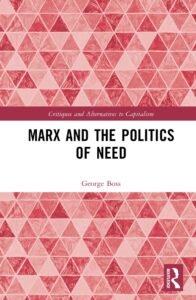
Routledge, London, 2026. 218 pp., £137.59 hb
ISBN 9781032879932
Reviewed by Matthew Rutherford
Needs occupy a central place in political debates; we need access to healthcare, we need public transport, we need economic growth, etc. But despite the prevalence of needs in our politics, needs themselves are generally taken to be apolitical. They’re seen as necessary and (quasi-)natural, and their origins are said to lie in – for example – our universal human condition. In Marx and the Politics of Need, George Boss challenges this traditional picture; needs aren’t timeless natural givens, rather they’re constitutively political. Needs are not just in our politics, but they are of our politics (13).
This thesis is the guiding thread that runs throughout the book. But Boss’ argument isn’t limited to this ambitious claim. He skilfully navigates controversies in Marx scholarship, re-reads Marx and Judith Butler alongside each other and gestures toward a new emancipatory politics of need. Boss provides a fascinating argument in four key moves: 1.) critique of analytic theories of need; 2.) a radically politicised reading of Marx; 3.) needs as reified ‘performatives’; and 4.) the critical project of re-presenting needs.
Boss diagnoses a common failing within analytic theories of need, where needs are de-politicised and treated in an ‘extra-political evaluative space’ (13). These normative accounts aim to distinguish the needs-that-matter from those that don’t. But our assessments of the needs-that-matter diverge radically (both within and across cultures). Faced with inevitable political conflicts over needs, analytic accounts tend toward political closure and aim to definitively resolve such debates. In Bonnie Honig’s words, they aim to get politics ‘right, over, and done with’ (35). Boss illustrates this by engaging with various analytic approaches (16-28), all of which (to varying degrees) seek to overcome and resolve the inherently political and conflictual character of needs. For Boss, the inevitability of political conflict isn’t a problem to be solved, but rather a constitutive feature of needs themselves.
Boss sees in Marx a theoretical posture that is better suited to do justice to the complex political reality of needs. But unlike dominant interpretative approaches, which see Marx as presenting a theorisation of need (that is, a unified extra-contextual account), Boss emphasises Marx’s political engagements and interventions. Marx’s writings have a decidedly political and polemical purpose that cannot be expunged. Boss reads the German Ideology not as an immature exposition of historical materialism, but rather as a polemical parody of his left-Hegelian contemporaries laced with irony and sarcasm. Here Marx provides a kind of reductio, ‘aping’ their idealist dialectical style only to reveal the material presuppositions (including needs) from which they’ve abstracted. Seen as such, the book isn’t providing a timeless theorisation of needs, but a polemical debunking.
Instead, Marx’s ‘emancipatory politicisation of need’ (38) seeks to radically historicise needs. It’s impossible to separate needs from a mode of production. Even as seemingly natural a need as hunger, taken independently of production, is a ‘vacuous empty abstraction’ which misses the historically variable ‘nature, purpose, subjective experience, and mode of satisfaction’ (95). To treat needs as extra-political categories is to abstract them from concrete social existence and obfuscate the power relations and historical variability intimately bound up with (and constitutive of) needs and needs-meeting activity. We are not abstract subjects endowed with abstract needs; we live, breath and eat in a definite system of production.
Boss’ politicised account argues that needs are fully politically constituted; they’re ‘political all-the-way-down’ (181). But there’s another possibility here; needs are politically mediated. Both claims politicise needs, but they’re importantly different. The latter grants need a limited independence (there’s something that’s being mediated), while the former denies it completely. The weaker mediation claim strikes as more preferable. We cannot consider a need-in-itself but only as it appears in its politically mediated form; for example, accepting Axel Honneth, our need for recognition is extra-political and ‘quasi-transcendental’ but only ever manifests in politically mediated forms (2003: 174). This accomplishes all Boss needs: reveal contingencies, conflicts and alternative possibilities, whilst maintaining the intuition that (some) needs extend beyond the political – which seems an easier pill to swallow. This also makes sense of the problems Boss sees within Critical Theory (28-34), that despite politicising needs they still maintain ‘true’ and ‘false’ needs in a seemingly extra-political sense. But if there’s an outside to needs, then there’s an unrealised normative potential that exceeds its prevailing one-sided interpretation. ‘Emphatic needs’, as it were, exceed and contradict the present – this draws on Peter Gordon’s (2023) interpretation of Adorno’s use of ‘emphatic’; emphatic concepts always contain an unrealised normative surplus.
Furthermore, without positing some needs-in-themselves which extend beyond the political, a politics all-the-way-down approach may struggle to adequately account for the strong necessity of needs. If needs are just historical political realities, accusations of voluntarism loom and it’s hard to account for the force of needs without positing it merely as the result of disciplinary and ideological power, which seems too strong. While Boss certainly doesn’t disregard their necessity – far from it, he considers them binding (political) realities – there’s a tension here between the necessity and political contingency of needs. Boss emphasises their contingency but risks neglecting their necessity beyond the (incomplete) binding force of power.
Boss further develops his account by reading Marx alongside Butler. He identifies ‘troubling’ as a common concern; Butler troubles gender, and Marx economy categories in much the same way, by undermining their apparent naturalness and re-presenting them as ‘performative’. Boss follows suit and sees needs as ‘economic performatives’; meaning that the category of need ‘arises through its continual redeployment in a repetitive pattern of everyday social practices, and which is impossible to reduce to any reality notionally external to those practices’ (84). As with all performatives, it’s almost a self-fulling prophecy: if we act as if gender is natural, then it becomes naturalised (for us); if we act as if needs are externally given, then they become external givens (for us). The appearance of impersonal quasi-natural economic laws, the reified commodity and naturally given needs are all performative accomplishments, achieved via the continual repetition of functionally mandated action.
While Boss skilfully (and critically) reads Marx and Butler alongside each other, some may find this problematic. After all, performativity is – for Butler – largely symbolic and discursive. Boss anticipates this and reinterprets performativity materialistically, focusing on material practices and the dialectical interplay between labour and nature (101-102). Although, there may be an opposing danger of over-emphasising the material only to risk losing sight of the discursive; needs don’t just have a material basis, but also a communicative one (180). More importantly, performativity and its emphasis on action is central for the politics of need. For Butler, the performativity of gender opens a space for agency to reshape gender. Similarly for Boss, troubling needs and revealing their performativity serves as a ‘site of agency and critique’ (119), opening new possibilities.
This brings us to the critical project of re-presenting needs. The politicisation of needs aims to prompt action by presenting capitalism in such a way that it brings its contradictions to the fore and draws out alternative possibilities. Boss details this through Marx’s discussion of wage-labour, which he reads as politically charged re-presentation designed to ‘expose its hidden stakes and internal conflicts’ (131). Boss’ detailed discussion here is excellent and cannot be fully reconstructed here. The general crux is that Boss (and Marx) seek to illuminate: 1.) the politics behind needs, the material and political preconditions underpinning wage-labour, for example, the division of labour which functions ‘by denying people the independent capacity to meet their needs’ (151); 2.) the politics enacting needs, which focuses on how abstract economic categories come to shape concrete social relations, for example, the struggle between capital and labour over contractual terms); and finally 3.) the politics following needs, drawing on Agnes Heller’s notion of ‘radical needs’ (with caveats), with Boss highlighting the needs generated by capitalism but can never satisfy.
The intention in this analysis is to re-present the everyday story of labour in such a way as to highlight its inhumanity, contingency and alternative possibilities. Marx’s critical re-presentation acts as a political intervention which aimed to:
feed the very struggles he had identified, equipping the actors within them with concepts that mapped the battlefield, prompting forms of action adequate to its terrain, and thereby helping to realise certain social possibilities rather than others (161).
It’s a politicisation that brings conflict and contradictions to the fore and calls us to arms. The outcome is a politics of need that turns ‘critical attention away from what needs themselves are, and to what those projects do’ (176). Boss invites us to look at how needs-talk justifies exclusion and forecloses politics, and by stripping away its reified form, pave the way for new forms of political action.
While Boss supports a politicisation of need, he also expresses some well-founded doubts; just because something is politicised doesn’t make it emancipatory, and just because something is de-politicised doesn’t make it oppressive (34). To navigate this, Boss tells us that ‘the task of politicisation must be guided by the normative orientation of a clearly articulated emancipatory project’ (37). But just what such a project is, is left largely unanswered. Throughout the book, there are scattered remarks, but none that really address it. But this isn’t a significant issue; Boss’ aims are critical and negative, and the intent is to re-present needs and open new avenues; which direction to take is a different question.
21 July 2026
References
- 2023 A Precarious Happiness: Adorno and the Sources of Normativity (Chicago: The University of Chicago Press).
- 2003 Redistribution or Recognition?: A Political-Philosophical Exchange. (London: Verso).

Comment on this review
No comments
View comments