
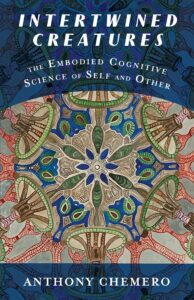
Columbia University Press, New York, 2026. 237 pp., $30.00 pb
ISBN 9780231223195

University of Notre Dame Press, Notre Dame, 2025. 221 pp., $28.00 hb
ISBN 9780268210335
Reviewed by Guy Lancaster
Cartesian dualism, never the strongest of premises, has come in for a right beating in recent years. Evolutionary theory had already broken down the barriers between the animal and the human, and further research into both primate and human cognition has largely disproven the existence of ‘mind’ as something separate from the body. In fact, the summary of his life’s research represented by Robert Sapolsky’s two most recent works, Behave: The Biology of Humans at Our Best and Worst (2017) and Determined: A Science of Life without Free Will (2023), has rendered irrefutable that line from Leonard Cohen’s 1992 song, ‘Closing Time’: ‘Your body’s really you.’ That our own personal intuitions or cultural inheritance on the matter might stand in contrast to the matter of mind simply does not matter in the face of the evidence. Or as Etienne Gilson once quipped: ‘There is more than one excuse for being a Descartes, but there is no excuse whatsoever for being a Cartesian’ (Gilson 1937: 6).
A corollary of the idea that mind stuff exists separately from body stuff is that other minds, if they exist, must be truly unknowable to us. One can witness the ubiquity and persistence of this notion in such journalistic tropes as ‘Sure, this techbro CEO consistently posts racist memes on social media, but does he really believe this stuff, or is he just trolling the rest of us?’ However, as Anthony Chemero argues in Intertwined Creatures: The Embodied Cognitive Science of Self and Other, other selves are not so opaque; in fact, ‘having a mind as an individual depends on your body and your interactions with the environment, tools, and other people. It is our history of engaging with other people that enables us to have minds of our own’ (xi). Not only is your body really you, but so are your interactions with the world at large. People are what they do, as Martin Heidegger put it, and so we need not engage in the delusion that Elon Musk might possess a private, secret self that is affable, articulate and egalitarian.
This is not to say that we lack private selves, for we do have personal memory and a subjective, steam-of-conscious experience of ourselves; but as Chemero argues, ‘the private self does not have the developmental or epistemological priority that the modern theory ascribes to it’ (42). In fact, he argues, this is the basic reality of our biology: ‘From the very beginning, we are coembodied, coenactive, cometabolizing with our mother,’ and this does not change when a child is born, for our early experience ‘is not of being an object that is experienced by another; rather, it is the experience of a cosubject in cowawareness’ (47). Infants need no theory of mind in order to engage with other beings; they simply interact with them, exhibiting from early on a sensorimotor empathy that demonstrates their connections to others.
After an opening section focused upon phenomenology, Chemero gets into the more technical matters of what he has dubbed ‘radical embodied cognitive science.’ This stands in contrast to the idea that the brain is really some kind of organic computer, and thus if you want to understand the mind, you need to understand the computational processes of individual brains. According to Chemero, there is mounting evidence that the brains of animals operate synergistically – that is, discrete areas ‘move into temporary coordinated patterns to enable animals to complete a task and become uncoordinated once the task is completed’ (71). Such synergies, or ‘interaction-dominant systems,’ are not modular but, instead, deeply unified, so that variability in any one component is propagated throughout the system,’ allowing the system to maintain a ’self-organized criticality,’ meaning that the system can easily switch behaviours, if need be. Chemero outlines how he and colleagues have performed experiments that demonstrate how human interactions with tools and technology alter the lived body, as Heidegger proposed in Being and Time, describing functioning tools as ‘ready-to-hand,’ or extensions of the human user. But synergies exist between people themselves, as with jazz musicians, dancers or even just people having a conversation, during which participants will unconsciously match the verbal complexity of their interlocutor. All of this, writes Chemero, is ‘not consistent with the Cartesian assumptions that define the modern theory of mind,’ implying ‘that the human mind is not a hidden, inner machine separable from the body, from action, from other humans,’ and thus leading us to the conclusion that ‘perceiving, experiencing, thinking, and the like are things that we do, not things that happen in our brain’ (87).
The minimal self, therefore, is not the isolated mind, the potential brain in a vat that is the object of so much freshman philosophy and bad science fiction, but is instead social, a part of the world. Cognition itself is social before it is individual. (There can be no individual cognition by definition, for the word, based upon its roots, means ‘to know together.’) Sure, we still have our inner monologue, but this is not the voice of some hidden, inner self: ‘Things we say to ourselves are tools, instruments, or artifacts that we create and use. […] The purpose of inner speech is not to represent the world accurately: thinking is rarely if ever a matter of aimlessly taking stock of the elements present in our surroundings and generating or updating an internal inventory of the world’ (123). And perhaps the main clue there is that our inner voices employ the language(s) with which we are most familiar, and language is a socially produced tool.
All of this has ethical considerations. After all, much of Western society is predicated upon the primary political actor being the autonomous individual (often imagined as white, male, able-bodied, cisgender, etc.). But if even the most minimal self is social, all we can truly achieve is what certain feminist thinkers have dubbed ‘relational autonomy.’ Anticipating Chemero’s observation that, at our very beginning, we are ‘coembodied, coenactive, cometabolizing with our mother,’ philosopher Grace Jantzen, in her 2004 classic, Foundations of Violence, observed: ‘It is possible to die alone, but it is not possible to be born alone: there must be at least one other person present, and she, in turn, was born of someone else. To be natal means to be part of a web of relationships, both diachronous and synchronous: it means, negatively, that atomistic individualism is not possible for natals’ (Jantzen 2004: 37). Thus do moral theories such as consequentialism and deontology prove a poor fit for our reality, according to Chemero, for they ‘force us to treat other humans as interchangeable’ and deny the reality of relationships (143-144).
Another way of saying that our existence, our sense of selfhood, is intertwined with others, is to say that it is dependent upon others. To indulge in a bit of etymology once more, the ‘twine’ portion of ‘intertwined’ denotes at least two strands twisted together to make a stronger thread, while the word ‘dependent’ can apparently be traced back to a Proto-Indo-European root ‘(s)pen’ that is the source of the Old English spinnan and thus our modern ‘to spin,’ as in the spinning of fibres. A spindle, after all, would hang (like a pendant) upon the fibres that its spinning motion would intertwine.
But somewhere along the line, the word ‘dependent’ attracted connotations of subordination. Most seem to agree that this occurred in the 1640s, coincidentally the same decade in which Descartes published Meditations on First Philosophy. Dependency, from that point, denoted not the nature of our reality but the nature of lesser creatures. This has had certain knock-on effects, for the very beginning of the Enlightenment was marked by a belief that dependency equalled inferiority; as women were regarded as more dependent, so did the so-called Age of Reason find new reason to support the idea of women’s inherent inferiority. ‘Women’s bodies and relationships are shaped by dependence,’ writes Leah Libresco Sargeant in The Dignity of Dependence: A Feminist Manifesto, ‘which makes us exceptional and unwelcome in a world that expects men and women to be autonomous (or at least to pretend to be)’ (2).
As Sargeant tells it, some of the dominant strains of feminism have operated on the basis of a false anthropology, concluding that equality can only be achieved through female autonomy, not recognizing that male autonomy was the lie that underwrote the lie of male superiority. Moreover, biology continues to belie the idea that men and women could ever be interchangeable, especially as it comes to reproduction, for ‘the baby’s divergence from the autonomous ideal points back at its mother, exposing her own deeply human ways of being marked by dependence. A baby, or even the potential of a baby, strikes at both the aspiration to autonomy and the illusion of interchangeability between the sexes’ (17). Ignoring the real differences between men and women leaves one unable to advocate for true equality.
Indeed, as Sargeant documents in detail, the physical realities of a woman’s life are often treated as disabilities to be overcome in order that women might participate in the economy on equal footing: ‘Rather than women being welcomed as we are, the price of our presence in society is to spend money, time, and social capital on cobbling together accessibility tools to move through the world as the imagined archetypal man does. These solutions aren’t limited to “fixing” women’s physical differences; they also aim to “solve” our relationships of care’ (45). These include, for example, breast pumps designed to let women express milk while at work and medical suppression of the menstrual cycle – and the work on developing artificial wombs is often pitched as letting the woman avoid the trouble of gestating a child. (That many celebrities already employ surrogate mothers for much the same reason goes, for some reason, unexamined by the author.) Sargeant even regards theories about the social construction of gender, such as those advanced by Judith Butler, as existing along this continuum, as yet another attempt to de-essentialize womanhood; what is, after all, only performative might be performed a different, less feminine, way. Even applying the language of labour to the work of caretaking is an attempt to strip away the reality of our relations of dependency and replace it with the rhetoric of the marketplace. In this, Sargeant echoes the work of Amy E. Wendling, who argued, in The Ruling Ideas: Bourgeois Political Concepts, that the concept of labour in capitalist modernity has functioned like a black hole into which are collapsed all other modes of human activity and relationship (Wendling 2012: 10).
Sargeant’s book is part of the University of Notre Dame Press’s ‘Catholic Ideas for a Secular World’ series, and she does regularly present as evidence for her views anecdotes that reinforce Catholic social teachings, citing women who were later glad they had not ended an unplanned pregnancy or rhapsodizing about the meaning behind a wife taking her husband’s last name. However, this does not make her book any less valuable. If, in right-wing circles, motherhood is often sanctified as the source and summit of true feminity, or, worse, embraced as necessary for the preservation of our superior race, motherhood can often be abstracted away into a constellation of individual rights on the left – the right of women both to become pregnant and avoid or terminate a pregnancy, the right to prenatal care, the right to state-sponsored childcare, etc. Few actually deal with the phenomenology of dependency evoked by the figure of expectant and new mothers and how the physical and mental realities of such dependency undermine any ideology that idealizes some form of autonomy. ‘Our culture is sometimes male-normed,’ Sargeant writes, ‘but, frequently, the norm women are trying to match is simply an inhuman norm, one that neither men nor women can comfortably inhabit’ (70). Or as she notes a few pages later: ‘A culture focused on expressive individualism and suspicious of the natural and the needed finds it easy to pathologize the real and idealize the pathological’ (76).
Meditating upon the reality of women’s dependence exposes the reality that all humans exist in such relationships of dependency with each other. Although the following words are Sargeant’s, they could easily have come from Anthony Chemero’s own work:
We are called, not to accommodate dependence as a brute, unpleasant fact, but to knit dependence deeply into our understanding of what it means to be a human being. Our ties to others are not an obstacle to self-actualization, they are the foundation for the authentic self. It is the places we are exposed to the world, our vulnerabilities, that allow us to extend ourselves in love and receive love in return (126).
And this raises the question: what might our society look like if we embraced the lived reality of people’s lives, if we acknowledged dependency as the foundation of our ostensibly individual existence, if we recognized our minimal selves as fundamentally social? What possible policies might be predicated upon the proposition that my own wellbeing is inherently connected to yours? What if we truly made a place for everyone, rather than just those who most closely adhered to some ‘everyman’ ideal? What if, for example, we had maternal leave policies that did not require women to leave their maternity at home but instead made a place for their whole selves in the labouring world?
Both Chemero’s Intertwined Creatures and Sargeant’s The Dignity of Dependence take the reality of our embodiment as the starting point for any serious philosophical and political reflection. Both of these books could rightly be called humanist manifestos in that they manifest a serious engagement with our humanity. Granted, some readers could be turned off by the technical notes in Chemero’s work or the Catholic underpinnings of Sargeant’s, but the fact that two people from such radically divergent intellectual backgrounds have both arrived, via their own paths, at a similar understanding of the world and our place in it should suggest to readers of either or both works that there is some measure of truth here. Whether or not this truth sets us free depends upon how we define freedom. After all, we moderns tend to define freedom as a state exempt from bondage, but the word ‘free’ actually derives from more ancient words meaning friendship, peace and love. And one never loves alone.
9 June 2026
References
- 1937 The Unity of Philosophical Experience (San Francisco: Ignatius Press).
- 2004 Foundations of Violence (New York: Routledge).
- 2012 The Ruling Ideas: Bourgeois Political Concepts (Lanham, MD: Lexington Books).

This review is licensed under the Creative Commons Attribution-NonCommercial-NoDerivs 3.0 Unported License
Comment on this review
No comments
View comments