
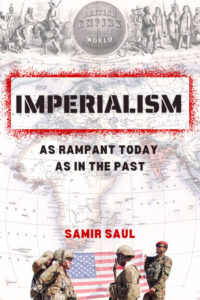
Baraka Books, Montréal 2025. 380 pp. $35.95
ISBN 9781771863827
Reviewed by Giampaolo Conte
Samir Saul’s book is undoubtedly one of the most comprehensive works published in recent years on the broadly conceived theme of imperialism. From the ancient world to the present, Saul provides a clear and compelling analysis of the nature, structure, and transformations of what is understood as imperialism—both within the Western world and beyond. Although the book is primarily a critical analysis of current and past studies on imperialism, it provides a convincing summary of existing works and theories. Clearly, it explains the evolution of this system throughout history.
In the first part of the book, Samir Saul highlights imperialist policies before the rise of modern capitalism. This approach directly criticises academic interpretations that reduce imperialism to a tool of modern capitalism. The long-term historical reading that Samir Saul promotes, on the other hand, highlights how imperialism is a structure for the organisation of power linked to very different historical periods, economic systems, and social structures. A central element of Saul’s analysis is the distinction between domination and political power, and between economic exploitation and economic power. Political control, however, always comes before economic advantages. In fact, ancient imperialism is fundamentally centred on the collection of taxes, access to resources, and the extraction of rents rather than on market relations. Central to this picture is the role of war, which is one of the constituent tools of pre-capitalist imperialism. In this way, the relationship between the centre and the periphery is consolidated, serving to maintain coercive control over certain territories, to extract resources not for accumulation but to preserve the empire’s strength, and to extend its power indefinitely.
From the very beginning, the author establishes one of the key points for understanding imperialism: an international economic system based on extra-economic means. Imperialism as a general category thus constitutes an instrument of overall coercion, enabling and expanding domination and conquest in both formal and informal terms, either through direct military action involving the territorial acquisition of specific areas, or through localised market control, exercising hegemony confined to the economic and financial sphere. However, it is under the capitalist mode of production that imperialism assumes its most varied forms, as it becomes tied to the “law of capitalist motion,” namely the tendencies and drives emanating from the logic of endless accumulation. Imperialism as a historically specific category, then, emerges in relation to economic theories, particularly those of Marxist and Marxian inspiration, which incorporate it into their theoretical frameworks aimed at explaining, in various ways, the inner workings of capitalism.
From mercantilism to liberal and neoliberal financial capitalism, imperialism remains intrinsically linked to the politics of capital expansion and to the extraction of value through economic and extra-economic means. Historically, however, it is only from the late nineteenth century onwards that imperialism began to be studied as a defined object of inquiry and analysis. This was due to the now “totalising” power of the capitalist production system and its obvious repercussions, both nationally and globally. In other words, the study of imperialism aims to identify and coherently explain the transformations in market capitalism following the free-trade crisis of 1873. Imperialism was soon identified as the “executive arm” of capitalist expansion into markets that were potentially lucrative for capitalist territorial power and its economic elites. The only major economist to seriously engage with the concept without being a critic of capitalism was Joseph Schumpeter, in his well-known work The Sociology of Imperialisms (1919).
Chronologically, Saul identifies several phases of imperial expansion. He begins with mercantilist imperialism, which gave way in the nineteenth century to free-trade imperialism, followed by neo-mercantilist imperialism, which ended after the Second World War. From a historiographical standpoint, considerable attention has been devoted to the so-called “classical age of imperialism,” roughly spanning 1870–1914. This was primarily thanks to Lenin’s best seller Imperialism: The Highest Stage of Capitalism, as well as to the works of Rosa Luxemburg, Rudolf Hilferding, Karl Kautsky, and John A. Hobson, among others.
Neo-mercantilist imperialism drew particular attention for several reasons, most notably the extensive use of both direct and indirect force to conquer and influence non-European societies. This process allowed the rate of profit to remain as high as possible, thereby avoiding the dangerous crises of overproduction that had already triggered the 1873 crisis and the so-called “Long Depression” of the late nineteenth century (though somewhat overstated).
It is precisely within this phase of expansion that Lenin justified the failure of the capitalist system’s predicted collapse in Europe, as foreseen by Karl Marx: colonies and imperialism themselves served as mechanisms to sustain profitability. Capitalist expansion through imperialism occurred not merely via the export of commodities, but increasingly via the export of financial capital. During this historical phase, which ended with the Second World War, the traditional form of colonial imperialism coexisted and overlapped with the more intangible, though no less coercive, forms of neo-mercantilist capitalism.
One of the strengths of Samir Saul’s book is undoubtedly his detailed analysis of the great thinkers of imperialism. The author analyses the evolution of theories of imperialism with historical rigour, without resorting to determinism. Saul does not distort the theory to fit a predefined thesis, but presents what has been written about imperialism in the most ideologically detached manner possible.
Britain, France, Germany, and the United States sought new spaces for capital outflow and profit-seeking opportunities. As Hobson (1902) argued, this occurred at the expense of a more equitable distribution of income within national borders: economic imperialism thus emerged as a necessity to safeguard the savings of the wealthier classes. Should internal wages rise within the capitalist nation, this pool of savings would shrink, thereby undermining the principles of capital export and financial imperialism. On the contrary, the export of capital served to avoid saturating the domestic market—thus further reducing the internal rate of profit and savings—while maintaining favourable conditions at home for social discipline and a minimally acceptable marginal rate of profit. The British case is illustrative. As Schumpeter himself observed—one of the few non-Marxist authors to engage with the notion of imperialism—British imperialism went hand in hand with Disraeli’s political need, after the Reform Act of 1867, to secure working-class votes by appealing to national pride as a means of defusing domestic class conflict. This was essentially the externalisation of a domestic problem. Likewise, Fabian imperialism can be understood as an attempt to utilise the empire’s resources to finance full employment and pension schemes, thereby supporting a tentative form of social policy. Additional resources derived from financial returns also served this purpose. From the 1880s onwards, returns on overseas loans began to surpass the profitability of manufactured exports, particularly as British industry gradually lost competitiveness to its German and American counterparts. Imperialism thus also functioned as an external response to an internally driven problem rooted in Britain’s industrial society. It was also viewed as an anti-cyclical measure to offset domestic economic downturns. Two chapters of the book (chapters 11, more empirical; and 12, more theoretical) are devoted to the classical epoch of imperialism. This undoubtedly helps the reader come to terms with classical theory and understand its evolution from both theoretical and empirical perspectives.
Samir Saul’s book, therefore, combines a rigorous analysis of classical and modern theories of imperialism, interweaving them with historical events from a long-term perspective. After 1945, imperialism took on new forms. With the process of decolonisation, the manu militari acquisition of new territories was no longer morally, politically, legally, or economically viable. Direct forms of control gradually gave way to indirect ones, applied to all countries that failed to comply with the rules of capital and the political directives imposed by the United States’ hegemony. The author rightly identifies the transformations of the 1970s—linked to what Baran and Sweezy called “monopoly capitalism”—and the rise of neoliberalism as marking a shift in imperialist policy.
With deindustrialisation in the United States, financial expansion began to take priority in the projection of American power at home and abroad. Financial profit became the main driver of expansion and value extraction through further control over supranational institutions (think of the change in the IMF’s role since the 1970s) and through the forced expansion of dollarisation worldwide, facilitated by the growth of the Euromarket and petrodollars since the 1970s. With the emergence of multipolarity, the old division between “developed” and “underdeveloped” countries consequently began to shrink thereafter. The dominance of the financial sector has reshaped American geopolitical and geoeconomic priorities. The destructive effects of capital’s profit-seeking, value-extracting practices afflicted many countries worldwide, especially semi-peripheral countries such as Latin American and Middle Eastern states, which suffered the most from American financial expansion. One need only consider the conditionality clauses attached to IMF loans to countries such as the United Kingdom (1976) and Italy (1974 and 1977), compared to those imposed on so-called “developing” countries following the sovereign debt crises after 1979. Subsequently, financial capital also lashed out against the same European countries overwhelmed by the disastrous 2007–2008 crisis.
Following the 2008 financial crisis, loans granted to Greece by European institutions and the IMF led to the first real application of the most coercive practices stemming from the deleterious effects of neoliberal financial imperialism to a country considered “advanced.” The latter thus began to take less and less account of the political role of some countries compared to others. The end of the Cold War made European nations such as Greece much less valuable to the political interests of the United States and its main European allies, such as France, Germany, and Great Britain, leaving capital free to pursue a policy of maximising value extraction. Post-2008, the world fully entered a phase that had been taking shape since the 1980s: the transition from a consumption-based economy to one centred on debt, in which finance and rentier capital have overtaken the industrial-productive sector in both importance and centrality. The more the debt economy expands, the more imperialism sheds its political rationales to become a pure instrument of value extraction—from any subject, state, or form of life bound by the logic of debt and credit. Although geopolitical issues still play an essential role in determining the degree of value extraction by one nation compared to another, debt imperialism operates within generalised extraction dynamics, aiming to maximise returns for the hegemonic state and the capital-owning elites.
As Samir Saul convincingly demonstrates, imperialism thus serves different masters depending on the historical period, prevailing interests, and the productive system to which it is attached—whether for political-military, industrial, or financial purposes. Imperialism becomes that element of the attempt to conquer supremacy, pursued since ancient times by various human societies. Saul’s book skillfully balances theoretical and empirical analysis, making it an invaluable tool for anyone interested not merely in a single aspect of imperialism but in its systematic investigation. Never before has understanding the nature of imperialism been more crucial to grasping the complex evolution of the international geopolitical and geoeconomic system. For those seeking to comprehend the present through a fundamentally historical approach, Saul’s work is essential reading.
1 February 2026

Comment on this review
No comments
View comments