
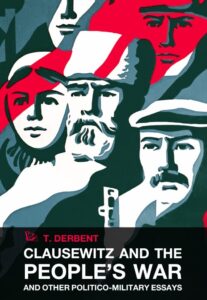
Foreign Languages Press, Paris, 2025. 464 pp., £13.00 pb
ISBN 9782493844651
Reviewed by Joshua Moufawad-Paul
Since the early 2000s, Belgian scholar T. Derbent has been writing and publishing rigorous Marxist studies on Clausewitz and military strategy. Aside from a few essays and small books, however, most of his work has remained in French, largely unknown to the Anglophone world. Hence, the recent translation and republication of his first book, Clausewitz and the People’s War, in a volume that also includes several other significant essays he wrote since, should be cause for celebration. As Derbent asserts in an essay included in this volume, the refusal ‘to develop a military policy as soon as the question of confrontation arises practically disqualifies [those who would see themselves] as revolutionary forces; they behave in advance as gravediggers of the revolution, as fodders for stadiums and cemeteries.’ (279) Derbent’s entire scholarship has been driven by the notion that comprehending military strategy is a necessity for the anti-capitalist left, just as counter-insurgency is a necessity for the capitalist state of affairs, and that if we fail to understand this necessity, there will be no revolution.
Although this volume of includes a number of Derbent’s essays, some of which were already published in English, this review will focus mainly on the previously untranslated eponymous book. Clausewitz and the People’s War and his (still untranslated) Clausewitz and Giap were understood to be the best analyses of revolutionary military strategy amongst those activists and organizers who wanted to think the practical means of making revolution, with a scholar rigorously thinking his way through categories of military policy from a revolutionary perspective. Thanks to Foreign Languages Press, we now have a translation, updated with input from the author, that includes a comprehensive glossary and a pull-out chart of revolutionary movements and military strategies.
Clausewitz and the People’s War is a small encyclopedia. Firstly, it functions as an historiography of Clausewitz’s biography and his work. Secondly, it serves as a rigorous summary of Clausewitz’s main ideas, as well as how these ideas developed in dialogue with preceding and contemporary military theorists. Thirdly, it is an historical materialist analysis of the time in which Clausewitz lived and wrote – including how he could have thought his analysis of war in the first place – and how his ideas could be adopted and thought by revolutionary movements outside of his own class commitments. Finally, it is an analysis of how his ideas were apprehended by key revolutionary figures as well as agents of imperialism and reactionaries. Derbent begins by noting that Clausewitz’s influence on the Marxist understanding of military strategy is ‘the equivalent of Hegel’s [influence] in philosophy,’ but that it wasn’t until Mao Zedong ‘that a revolutionary military policy was fully and coherently theorized.’ (13) Indeed, Derbent’s thesis is that Clausewitz’s work contains key insights that are axiomatic for understanding people’s war (particularly its comprehension of partisan and guerrilla warfare), and that the success of revolutionary wars to date largely have to do with how well these insights are comprehended and creatively developed.
Clausewitz’s famous maxim, that war ‘is the continuation of politics by other means,’ is a key theme in Derbent’s analysis, particularly because he believes that it has been commonly misunderstood. He notes that that the maxim’s reversal, used by Foucault and others, that politics is also the continuation of war by other means, is ‘either a superficial approach to this thought […] or a deliberate rejection of his theses.’ (32) Although he notes that antagonistic politics (such as class politics) are indeed a continuation of war, Derbent’s point is that the totalizing reversal misunderstands the point Clausewitz was making about the strategic relationship of politics to war, conflating the categories of politics and war. Moreover, the Nazi approach to warfare – which claimed to transcend Clausewitz – was openly premised on this reversal (125-126), as was Schmitt’s attempt to recruit Clausewitz into his definition of ‘politics as the process of designating an enemy.’ (158) Against such misreadings, Derbent emphasizes the ways in which Lenin, Mao and Giap (among others) understood this relationship between politics and war as key to developing a revolutionary conception of military strategy, where politics were in command of militarization rather than militarization determining politics. This understanding of Clausewitz’s conception of ‘war as an instrument of politics’ (98), though fundamental for these thinkers, differed on the conceptual content of politics because, for the Marxist tradition, there was ‘new, broader, and deeper conception of the political subject’ than what was found in Clausewitz, with the latter largely unable to think of the political subject beyond the state. (159)
Following the conception of ‘war as an instrument of politics,’ Derbent provides a fascinating genealogy of the readings, implementations and debates surrounding Clausewitz in the revolutionary movement. Since this genealogy also discusses non-Marxist and anti-Marxist engagements with Clausewitz, while providing summaries of his main concepts, let us focus on key insights. First of all, Derbent notes how Engels was the first ‘attentive reader of Clausewitz’ (78) in the revolutionary tradition, and demonstrates how much of his ground-breaking work on military strategy was influenced by this reading. Secondly, Derbent discusses the ways in which Franz Mehring, who was instrumental in lifting Engels’ work on military strategy ‘out of obscurity’ (84), was also a disciple of Clausewitz, recognizing him ‘as a genius theoretician’ while also ‘expos[ing] his limitations.’ (87) Thirdly, Derbent examines Lenin’s comprehensive study of Clausewitz’s On War, subjecting it to his understanding of politics, as the first substantial analysis of military strategy from a Marxist perspective. That is, correctly understanding the meaning of Clausewitz’s famous maxim, ‘Lenin added a new dimension: by examining the political nature of war – in the final analysis, its class character – we can understand its historical and moral character, and thus distinguish between just and unjust wars.’ (93) Indeed, Lenin’s reading and implementation of Clausewitz was developed according to the concrete aim of making revolution and, beyond that, dictating the ways the Red Army would defend the revolution in 1918. (100-101) Derbent expands on the importance of Lenin’s reading and implementation of Clausewitz in another essay included in this book, ‘Lenin and the War,’ that was initially published, in two parts, in the journal Material.
After Lenin, the Marxist comprehension and implementation of Clausewitz’s axioms becomes conflicted. Trotsky, who did not think there could be an axiomatic approach to warfare, dismisses Clausewitz (61), rejecting the possibility of a specifically proletarian conception of war that Lenin was indicating in his studies. Indeed, Trotsky and others would be involved in a debate surrounding military strategy, where multiple sides drew upon Clausewitz in 1921 and that Derbent expounds upon in a later essay. Most oddly, however, was Stalin’s ‘gross misrepresentation’ (119) of Clausewitz directly following World War II, associating his theory with the military strategy of the Nazis. Such a conception was odd because, as Derbent painstakingly notes, the Soviet generals of the war were schooled in Clausewitzian principles and, unlike the Germans who cited Clausewitz out of a sense of national pride, actually pursued them in warfare, whereas Hitler’s strategy was anti-Clausewitzian. ‘While the Soviet military policy was able to reconcile a publicly voiced critique of Clausewitz with an eminently Clausewitzian practice,’ Derbent writes, ‘the Prusso-Germanic school succeeded in combining its worship of Clausewitz with a practice that was increasingly divorced from Clausewitzian principles.’ (120) As noted above, Hitler and his generals reversed Clausewitz’s famous maxim regarding politics, while also subordinating their entire strategy to surprise attacks, precisely the kind of strategy Clausewitz thought was foolhardy. Hence, the Stalinist rejection of Clausewitz, Derbent argues, was largely a product of the postwar ‘ideological realm, at a time when Soviet patriotic values were being promoted […] in ways that sometimes echoed the old, loathsome tunes of Great Russian chauvinism.’ (119)
But it is following this dismissal of Clausewitz by the Soviets that his theory would experience the most productive renewal. Mao Zedong’s theorization of protracted people’s war would serve, according to Derbent, as the most thorough and comprehensive conception of military strategy from the revolutionary camp, and it was largely influenced by Mao’s reading of Clausewitz alongside Sun Tzu. Moreover, Mao’s ability to reaffirm significant Clausewitzian principles was due to the fact that ‘they had similar methods of thinking and theorizing.’ (135) Mao also critiqued the Soviet rejection of Clausewitz as one of ‘the weaknesses of Stalinist dialectics.’ (137) After Mao, Giap became a disciple of Clausewitz in his theorization of anti-colonial guerrilla warfare in Vietnam. Like Mao, he was not a mechanical disciple, but a revolutionary who read Clausewitz thoroughly while he ‘applied or reinvented Clausewitzian doctrine in the specific context of revolutionary warfare.’ (145)
After discussing Mao and Giap, Derbent examines the more recent revolutionary wars in Peru and Nepal, noting the ways in which the Maoist conceptions of protracted people’s war not only followed Mao’s work but also returned to Clausewitz, based on the admissions of Gonzalo and Pasang, respectively. He also examines the Castroist-Guevarist tradition, pointing out the ways in which Guevera’s conception of strategy differed from Clausewitz’s insights to its peril – a notion he expands upon in a later essay in this collection regarding Marighella. Finally, near the end of the study, Derbent looks at the example of the Red Brigades, and how their military degeneration was linked to Renato Curcio’s ultra-leftist rejection of Clausewitz. (162-163)
Derbent concludes his study by noting that ‘in practice, Clausewitz was almost always in favor of a critical but methodical use of bourgeois military art – the people’s and proletarian character of revolutionary warfare did not invalidate his proposals, but enabled his limitations to be overcome, and the foundations to be laid for a proletarian science and art of war of a new type.’ (169) What was this new type? Earlier in the text his thoughts on this are quite clear: whereas Lenin’s initial foray into Clausewitz were exemplary, they resulted in the mechanical conception of the theory of insurrection, ‘a revolutionary strategy condemned by Clausewitzian orthodoxy [because it] claims to “surprise” the bourgeoisie through the massive outbreak of armed mass struggle.’ (51) Strategy based on surprise is largely doomed to failure, according to Clausewitz, and Derbent points out that in most cases this strategy of insurrection did indeed doom itself to failure, such as the KPD insurrection in 1933. Instead, Derbent points out that Mao’s conceptualization of ‘protracted people’s war’ might in fact be ‘the Marxist-Leninist form of revolutionary war’ (62) inherited from Clausewitz’s axioms.
The only lacuna in this masterful genealogy of politico-military analysis is the absence of engagement with Karl Liebknecht’s Militarism and Anti-militarism. Not only because Liebknecht attempted to produce an analysis of the bourgeois state’s military strategy, which was the strength of his work, but that he counter-posed it to a strategic line of anti-militarism that Derbent critiques in his section on Lenin. Overall, however, Derbent has produced a foundational work of Marxist politico-military strategy that, decades after its initial publication, is finally available in English. Hopefully his other books on the same topic, namely Giap et Clausewitz and De Foucault aux Brigades Rouges, will also be translated for those of us, like Derbent, who know it is important to think military strategy in the face of bourgeois hegemony.
23 July 2025

Comment on this review
No comments
View comments