
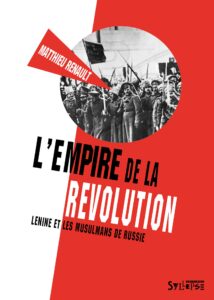
Éditions Syllepse, Paris, 2017. 148 pp., €11 pb
ISBN 9782849505649
Reviewed by Marina Gerber
Matthieu Renault’s L’Empire de la Révolution: Lénine et les Musulmans de Russie [The Empire of the Revolution: Lenin and the Muslims of Russia] presents a focused and brief analysis of Lenin’s writings and correspondence which concern his critique of Russian imperialism and ideas associated with the decolonization of the Russian Empire after the Revolution in 1917. The reader may wonder, why a scholar of post-colonial thought as Renault, chooses Lenin as the main figure for his analysis. The introduction which is titled ‘Lénine Decolonial’ addresses this question by pointing out that Lenin is not only part of the socialist imaginary as he personifies the spirit and hopes of the revolution before they were betrayed by Stalin, but also of the Marxist idea of the global anti-imperialist revolution. Furthermore, the Soviet Union’s political support of post-colonial struggles across the world in the 1960s is sometimes associated with anti-imperialism, which appears to be at the heart of socialism. But can we find properly decolonial ideas in Lenin, such as the break with Eurocentrism, asks Renault. His answer is ‘No’ before his analysis is even started.
What then is the point of the book? Referring to Rinat Voligamsi’s Unofficial Album (2005-06) Renault’s book begins with drawing attention to myths about Lenin, which characterise him as a radical subaltern. This, according to Renault, is not only fiction, but also obstructs the way of understanding the significance of the debate between Marxism and decolonial thought. The point of the book, as it is explicitly stated, is to rethink the very terms of the debate ‘Marxism against decolonial thought’ (13-14). However, the character of this debate is presupposed by Renault and the reader cannot be sure what exactly he is proposing to rethink other than the opposition itself. If in his essay ‘Rupture and New Beginning in Fanon’ (2011) Renault advocates for a measured Marxist postcolonial discourse that he discovered in someone who is known as anti-colonial, Frantz Fanon, here the question arises how Lenin could be a comparable figure. Other than the fact that Lenin had a multi-ethnic background, his views, as Renault points out himself, were Eurocentric in many ways. The myth of the decolonial Lenin presents Lenin as the flipside of Fanon, namely a Marxist who turns into an anti-colonialist. This is at least the contentious point of departure, which Renault backs up with the reference to the myth of ‘the other’, Islamic, Lenin. The supposed aim of this rhetorical coup is to create tension and to alert the reader of the perils of radical decolonization. The potentially Islamophobic subtext of this provocation was presumably not Renault’s intention. It is very clear from the book that he finds Islam to have repressive aspects, the liberation from which he advocates (‘Epilogue: The Unveiling of women’). At the same time, he carries out his analysis without forgetting to criticise the way in which the Bolsheviks proceeded in the former Russian colonies after the 1917 revolution. The coherence and vigour of this criticism is what this review assesses.
There is a number of studies on the period around the revolution focusing on early Soviet politics, the civil war on the borders of the Russian Empire and the Soviet Union, as well as on the role of Russia’s Moslems. What is specific about Renault’s book is that it sees these extremely dense historical events exclusively through the eyes of Lenin and the comrades who were directly involved in the regions, such as Mirsaid Sultan-Galiev or Georgy Safarov. There is little contextualisation and Renault points out himself that the book is neither a history nor a book of theory, but a work on the ‘power of ideas in history, and its limits’ (16). The book can be described as a presentation of the fight of Lenin’s ideas against reality and, possibly, against himself.
The book has two chapters dedicated to Lenin’s writings before the revolution, four chapters on the events after the revolution and an epilogue. In the first chapter, ‘De la colonization interne ou la Russie Américaine,’ Renault demonstrates that Lenin was critically aware of Russian colonialism and that he explicitly compared it to Western European colonialism. Born in Simbirsk (now Ulyanovsk), Lenin studied in Kazan, where the tensions between Russians and Tatars made him feel like it was ‘a remote colony where maintaining order meant resorting to violence’ (19). This is where he began to study Marx. In his first book, The Development of Capitalism in Russia (1899), Lenin says that what the Russian colonisers are doing in Ufa in Bashkiria by exploiting the wildlife and transforming the lands that provide sustenance for the Bashkirians, is what the Germans do in Africa. The central point here is that Lenin’s critique of colonialism is entwined with his critique of capitalism. The new Russian colonies in the steppe provided the centre with agricultural produce. This led to a ‘process, which is based on the structural division of the production space in the centre and periphery, which, as Lenin assures, is nothing other than an exemplification of Marx’s theses on “capitalist colony” in the third volume of Capital.’ (21) ‘The south and south-east of European Russia, the Caucasus, Central Asia, and Siberia serve as something like colonies for Russian capitalism and ensure its tremendous development, not only in depth but also in breadth.’ (24).
Regarding the term ‘internal colonization,’ Renault could have been more critical. The term was used by Russian historians to describe the processes of extension of the Russian Empire and the economic exploitation of the annexed regions. As Alexander Etkind’s Internal Colonization (2011) has – perhaps unintentionally – shown, the term contributed to a particular imperialist self-deception: the idea that Russia colonized itself and not others. Lenin does not seem to depart from this idea even if he is critical of its capitalist element. We see here how Lenin’s understanding of colonisation as ‘internal’ could have possibly been an obstacle in critically assessing Russian history. This potentially means that Lenin believed that by decolonizing Russian colonies he would effectively decolonize himself. In other words, the concept of ‘internal colonization’ enables a deceptive compromise with decolonial thought, namely that effectively an external power, which has a claim in becoming the central power, is imposing its own decolonization procedures. In any case, the effective re-colonization of the former Russian colonies is presented in the book as a necessary compromise that is needed to build the Soviet Union. But for future studies on the history of (de-)colonial ideas in Russian and the Soviet Union, it will be necessary to assess the degree to which the idea of ‘internal colonisation’ contributed or even enabled the internalization of decolonial struggle itself, which is a problem that Renault’s book is not able to address.
The second chapter, ‘De l’Autodétermination Nationale ou l’Algérie Russe,’ is dedicated to the famous question of national determination. Lenin was supporting various nationalist claims, including those of the Polish Marxists to reconstitute the independence of Poland. However, what he had in mind was not a bourgeois nation, but a communist or socialist state. Lenin was happy to support nationalists especially in countries and regions which he considered as colonies and semi-colonies of the Russian Empire, such as Finland, Poland, Ukraine, Khiva, Bukhara, Estonia and Courland (47), but only as long as they fought capitalist imperialism. In the third chapter Renault shows how Lenin’s relative tolerance of nationalism was tested in the context of Bashkirian or the Bashkortostanian autonomy conflict in 1919 and 1920. Lenin’s pressing question was: will the Bashkirian military forces fight against the White Army or do they need to be disarmed? Will they submit to the Red Army and become Socialist and Soviet voluntarily, or do they need to be forced? Lenin hoped that propaganda alone will seduce the population of the Russian colonies to side with Socialism. But it turned out to be more complicated and the Bashkirians ‘went too far: their war for the national emancipation has transformed itself into a war against the Soviet power’ (72).
The chapters ‘Decolonize Turkestan’ I and II shed more light on compromises that Lenin was forced to make in these colonies. Just after the revolution, Lenin engages in a highly symbolic act of restitution, by ordering the return of the Samarkand Kufic Quran to Tashkent, an eighth or ninth century manuscript that was sent by the Governor-General of Turkestan, Konstantin von Kaufman, to the Imperial Library in Saint Petersburg (74). But his objective was to gain power in the region, in order to engage in political and economic relations with Iran and India as well as make profit for Turkestan, but mostly for Russia (78). According to Renault, ‘the consolidation, i.e. the survival, of the Soviet regime seemed to Lenin inconceivable without the reinvestment of the material-economic infrastructures of Russian imperialism, and without the reactivation of the colonial logic of resource extraction from the peripheries.’ (79) Renault states that Lenin’s wish for ‘non-imperialist centralization’ and his tolerance towards national self-determination evaporated when facing (post-)colonial Central Asia (79-80). Even if some socialists in the regions agreed that they were exploited by capitalism, there seems to have been fundamental disagreements about the ‘decolonization’ procedures imposed by the Bolsheviks.
As part of the politics in the former colonies, the korenizatsia campaign aimed at fighting grand-Russian chauvinism and nationalism by enabling national minorities to hold important posts. But according to Renault, Lenin had something much more ambitious in mind, namely not merely integrating the national minorities into the new Empire and reconstructing it by reform, but destroying colonial structures (132). However, Renault points out that Lenin, even if he wanted to, probably could not have done anything about it, since this would have meant ‘mortgaging the existence of Soviet Russia itself’ and ‘mortgaging the victory of the Russian proletariat itself’ (133). In other words, Soviet Union would not have been possible without the re-colonization of the peripheries.
Renault concludes by gesturing to the civilizational powers of the Soviet Union and the liberation of women of the ‘unveiled Empire’ (l’Empire dévoilé). He also references Langston Hughes’ A Negro Looks at Soviet Central Asia (1934), hailing the liberational achievement of the Soviets in the region, suggesting Renault’s indebtedness to the socialist project despite the unresolved ‘debate’ between Marxism and decolonial thought.
Much more can be said from a Marxist perspective about these unresolved issues, e.g. by addressing the concept of ‘internal colonization,’ and also examining the extent to which the Soviet politics with which we are dealing is post-imperialist politics, and the extent to which they incorporated imperialist sensibilities, rather than breaking with them. Last but not least, Renault’s book implicitly points to the necessity of rethinking the relationship between myth and Marxism. His reference to myth, and specifically to the decolonial as myth, restages the tug of war between reason and irrationality. Rather than merely pointing to its perils and producing fear-mongering images, we should be able to assess the decolonial myth constructively and take it more seriously, precisely because of its currently increasing power.
13 February 2023
References
- 2011 Internal Colonization: Russia’s Imperial Experience (Cambridge: Polity Press).
- 2011 Rupture and New Beginning in Fanon: Elements for a Genealogy of Postcolonial Critique Living Fanon: Global Perspectives ed. Nigel C. Gibson (New York: Palgrave Macmillan).

Comment on this review
No comments
View comments