
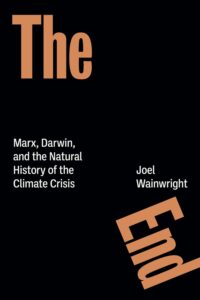
Verso, London, 2025. 337 pp., £19.99 pb
ISBN 9781804299418
Reviewed by Marcus Bajema
One remarkable characteristic of human beings is our tendency to conceive of ourselves as separate from the rest of nature, as if forming a kingdom in a kingdom, as Spinoza put it. Those of us who want to consider the ‘nature of things’, as they are rather than how we imagine or desire them to be, have to fight a virtually unending battle against this tendency. Joel Wainwright in his new book The End: Marx, Darwin, and the Natural History of the Climate Crisis has provided an important contribution in this regard. In making visible the deep influence of Darwin on Marx, he powerfully shows how the latter conceived of human history as a continuation of natural history.
The End is composed of three parts. In the first, composed of three chapters, Wainwright traces the intellectual trajectory of Marx before Darwin, Darwin’s discovery itself,and its subsequent influence on Marx. Part two has two chapters that reveal the pervasiveness of a natural historic perspective in volume I of Capital, attributing this to Marx’s encounter with Darwin. This analysis is broadened in part three of the book, where Wainwright tracks the impact of these ideas for the history of capitalism as well as for philosophy. The epilogue thinks through the possibilities for moving beyond capitalism in a world facing the climate crisis, formulating an alternative he terms ‘Climate X’.
The starting-point of Wainwright’s account of the early Marx lies in his relation to Hegel. He emphasises how Hegel’s philosophy of history was conceived as a theodicy, a justification of God. The most terrible misfortunes, the prevalence of the basest instincts plays, in the end, a logical part in the historical unfolding of the human potential for freedom. Reason for Hegel rules the world, and is actualised in different incarnations of Geist, the ideal and objective existence of collective consciousness. Marx broke away from Hegel’s views, returning not to earlier versions of materialism but formulating a new perspective on human self-realisation through (cooperative) labour, without any pre-determined goal.
The author then turns to Darwin, noting briefly the intellectual context from which the theory of natural selection emerged in 1859. One aspect that set Darwin apart was his ‘dialectical’ conception of species, as forms in a constant process of becoming according to shifting combinations of adaptive traits. The recognition that the Earth’s history stretched back many millions of years by Charles Lyell in the 1830s was an important influence on Darwin, allowing enough time for natural selection to lead to more complex animals. Darwin’s theory was thoroughly anti-teleological, going so far, as Wainwright notes (66), to liken thought to a mere secretion of the brain, an idea far removed from Hegel’s directing Reason.
As is well-known, Marx valued Darwin’s work for its defeat of teleological ideas in the realm of nature, and Wainwright argues in ‘Marx after Darwin’ that this impact was far more pervasive than has been generally assumed. Work on the ecological aspects of Marx’s thought in recent years has successfully reestablished the centrality of the metabolism of humans and nature in his mature works. Wainwright goes further, arguing that Capital can be understood as a ‘natural history of socio-economic formations’, as indeed Marx himself seems to indicate in the preface to the first German edition (90-91).
Chapters four and five of The End further develop the notion of Capital as a work of natural history, dealing with aspects of population, labour, technology and value. His treatment reveals many important aspects of Marx’s thought that were hiding in plain sight, as it were, but which are accentuated when viewed from a natural-historic perspective. Of particular importance is Wainwright’s point that for Marx every mode of production has its own ‘laws of population’ (150). For capitalism in particular, the relation between the expansion of capital and the size of the proletariat is crucial, and distinct from the agrarian-focused demographic cycles of pre-capitalist modes of production.
Wainwright rightly exhorts Marxists not to be afraid of discussing population. Indeed to do so is crucial, especially to engage with rival theories such as structural-demographic theory. Originally developed by Jack Goldstone to investigate the connection between population growth, elite exploitation and competition, and state finances, in early modern revolutions, it has since been extended to industrial and post-industrial social formations by Peter Turchin. Most notable in this regard is Turchin’s prediction of a systemic socio-political crisis in the United States from the late 2010s onwards.
Two aspects dominate in Turchin’s use of structural-demographic theory. The first is a secular cycle that starts from population growth enabled by favourable conditions and new technology, the latter distinguishing it from pure Malthusianism, leading to labour oversupply, depressing real wages and the immiseration of the general population. The second aspect is what Turchin calls the ‘wealth pump’, quantified by a declining relative wage (median wage divided by GDP per capita). Just as there is an oversupply of labour, so there can be an overproduction of elites that seek to drink from the wealth pump, putting a further strain on resources, especially on state finances. As elites compete for dwindling opportunities, this can lead to the formation ‘counter-elites’ emerge that can potentially initiate a revolution.
No intrinsic distinction is made in structural-demographic theory between different modes of production, so that it is as applicable to the collapse of Classic Maya civilisation as to the United States of the 2010s and 2020s. However, if each mode of production has its own ‘laws’ of population, then in a capitalist setting this would point to the causal nexus of population growth, proletarianisation, within the dynamic interplay of the forces and relations of production. Just as for the Classic Maya population growth would be relative to the finite resource base of rainforest agriculture, and be structured by the interplay of a communal-based, marketplace-enabled economy and a more exploitative state-based tributary sphere.
As global demographic trends become more complex, having shifted from population growth across the board to a plurality of trends, a Marxist perspective becomes crucial. For these dynamics do not appear so much as secular cycles as the result of an interplay of many factors, mainly social ones, structured by the (capitalist) mode of production. It is precisely Wainwright’s notion of Marxist natural history, with its combined understanding of human-nature and human-human relations, that can capture demography comprehensively, in contrast to Turchin’s theory where they are stitched together as parallel developments.
Chapter six of The End provides a useful sketch of human history as a whole, so far, from a Marxist natural historical perspective. Wainwright identifies four main transitions in history (240-241): the emergence of Homo sapiens about 400,000 years ago, the first states that develop between 10,000 and 5,000 years ago, the beginning of capitalism 300 to 200 years ago and a future (ecological) communism. As a sketch it is a plausible one, except for the strange omission of the domestication of plants and animals, also known as the Neolithic revolution. Of course, it remains not more than an outline, for rubrics like ‘states’ are broad leaves that cover a great variety of social formations, which are not so easily reduced to a common logic.
Wainwright’s focus lies on the natural history of capitalism, arguing that his perspective can fruitfully bring together different approaches that emphasise (enduring) primitive accumulation, the reproduction of capital in the capitalist mode of production proper, conspicuous consumption, as well as colonialism. He points also to the impact of biogeographical factors, not in a determinist but in a possibilist sense that allows for the role of chance factors in the emergence of capitalism. His analysis shows the potential for a natural historical approach. As this perspective was ‘hiding in plain sight’, to use it productively doesn’t imply starting anew but rather to view existing work from a different angle, and pursue new topics.
That is the practical side of things, in terms of theory some qualifications can be made. For example, Wainwright highlights Marx’s notion in the 1857 introduction of the Grundrisse that the capitalist mode of production supplies the key to the forms preceding it, as an example of teleological reasoning (233). This for him marks a major distinction between the Grundrisse and volume 1 of Capital, induced by the impact of Darwin.
However, this passage can (and has) been read quite differently, as simply tracing back the steps that have led toward the present mode, as Marx himself points to in the introduction when he refers to world history as a result, as the ‘vindication of chance’. In fact, teleological reasoning is usually understood as the (historical) unfolding of an essence, for example of human nature. Wainwright treats such questions in chapter seven of The End, where he focuses on the philosophical ramifications of Marxist natural history. His first transition, the emergence of humankind, is not treated in any detail, and the discussion is instead philosophically oriented and ends at Gramsci’s insight that human nature is located in the ‘ensemble of social relations’ (264).
This is unfortunate given another discussion in chapter seven, where Wainwright critiques Marx’s notion that human labour differs from animal activity in being consciously applied (265-275). For him labour as agency is more unconscious, at one point seeing parallels with crows. The question, however, is whether the consciousness involved in labour has to be seen in terms of individual agency, or that, following Evald Ilyenkov, the actions of individuals are mediated by objectively existing ideals. The evidence of early humans points to the latter, for example in the sequence of steps to make a hand axe, which are executed in consistently the same way over countless millennia. Here such ideal ‘plans’ mediate labour.
Overall, these qualifications are peripheral to Wainwright’s broader aims in The End, which are to be commended and followed up by further work. Not least to flesh out his notion of Climate X as a means to enable the transition to communism. As it stands, this is a plausible combination of associations of free producers and a ‘world republic’ providing mutual defence for said associations. One would like to see a more concrete connection between the recent natural history of capitalism and the realisation of Climate X, especially with regard to the geopolitics that are so intertwined with the political economy that has created the crisis.
The End shows us how central the notion that human history is an extension of natural history was for Marx, and how much we have to gain if we follow in the same track. Wainwright’s emphasis on population, in particular, has an urgent relevance for understanding its role in socio-political shifts around the globe. By (re)introducing the crucial socio-economic element of Marxist thought in demographic studies, a more fully-developed method emerges, avoiding the pitfalls of structural-demographic theory and similar approaches. Furthermore, a ‘natural historical’ approach provides an alternative way for Marxism to engage with the sciences than the ‘ontological’ approach of dialectical materialism, and avoids the solipsism of ‘humanistic’ approaches that view humans as a separate kingdom within the kingdom of nature.
25 November 2026

Comment on this review
No comments
View comments