
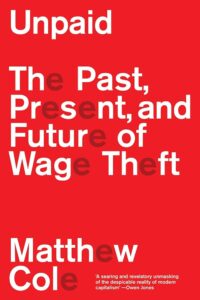
Verso, London and New York, 2026. 270 pp., $24.95 pb
ISBN 9781804295663
Reviewed by Karlo Marušinac
An employer who pays every legally required wage can still exploit workers through appropriation of surplus labor. Matthew Cole’s Unpaid: The Past, Present and Future of Wage Theft asks what this relationship between lawful exploitation and unlawful underpayment reveals about capitalist property. Combining labor research, historical analysis and political philosophy, Cole connects familiar workplace grievances to the organization of production itself. The book offers an introduction to the Marxist conception of wage theft, with strengths in explaining the institutions that make unpaid labor profitable. Its biggest difficulties concern the justification of collective ownership and the political transformation required to achieve it.
Cole’s central proposition is that ‘wage theft sits within a broader continuum of unpaid labour’ (7). His preface makes clear that property is at issue. The argument has three related purposes: to explain apparently exceptional and deeply personal grievances as structural problems; to demonstrate why legal compliance cannot abolish exploitation; and to make socialist alternatives imaginable. Its seven chapters move from contemporary violations through the histories of unpaid labor, property and labor-power to wage theory, digital capitalism and gig work. The title very accurately captures the book’s range, while understanding how much of it concerns earlier forms of unpaid labor, property theory and socialism.
The opening chapter examines the United States, Britain and China. Withheld payments, unpaid overtime and employment misclassification recur across different labor market regimes (13). Cole shows how subcontracting obscures responsibility and weak enforcement makes underpayment commercially rational. His account of exclusions from the American Fair Labor Standards Act connects New Deal protections to racial inequalities, while discussion of ‘polyworking’ identifies the pressures driving people towards multiple insecure jobs (19). Mechanisms like these explain why formal rights offer limited protection when workers cannot afford dismissal, litigation or retaliation (or may even have to fear retaliation from their employers). Recovering wages requires resources and organization that those most exposed to wage theft frequently cannot afford.
The historical discussion challenges the appearance of employers and workers meeting as independent equals. Enclosure, colonial dispossession and slavery helped establish the conditions under which people became dependent on wages. Class power operates through ownership and through institutions regulating access to subsistence. Race consequently enters the analysis through the constitution of labor markets, rather than appearing merely as an additional disadvantage.
Cole’s method is best understood as a Marxist historical and theoretical synthesis, supported by documentary evidence and contemporary research. His comparative country discussions illustrate different institutional arrangements; they do not constitute a standardized comparative study. The source base combines classical political economy with legislation, enforcement records, labor research and historical scholarship. Cole also draws on earlier collaborative empirical work. The book should be assessed for the accuracy and coherence of its synthesis. An absence of new fieldwork would be an unreasonable basis for dismissing a project which has a primarily explanatory character.
On the philosophical front, Cole examines Locke’s connection between labor and property, including the tensions introduced by money, servants’ labor and colonial conquest. Reading liberal property theory against itself, he asks why collective production should yield products exclusively controlled by private owners (76). This immanent critique challenges bourgeois ownership through its own justificatory principles. Cole reconsiders Marx’s dispute with Proudhon, emphasizing their shared recognition of workers’ uncompensated collective contribution (84). This convergence is Cole’s interpretation, and one of the book’s more provocative philosophical arguments. It shifts attention from their personal hostility towards the substance of their criticism of appropriation – and Cole shows they might have had much more in common than either would have liked to admit.
Their common concern, however, does not establish agreement about its explanation. Cole acknowledges Marx’s objections to Proudhon’s abstract treatment of property and theft. Whether these differences can be subordinated to a shared claim of producer entitlement requires further argument. The difficulty becomes sharper when Cole attributes to Marx a natural right to collective property. A passage cited in support belongs to Marx’s exposition of Locke’s position (Marx 1863). Explaining that position does not establish its adoption. Cole’s account would benefit from distinguishing more clearly between exposing contradictions within liberal theory and demonstrating Marx’s commitment to an alternative natural entitlement. The latter cannot simply be inferred from the former.
That problem also bears on the proposed alternative. A claim to the products of one’s labor cannot by itself decide how society should support children, pensioners or people unable to work. Cole recognizes this in his discussion of Marx’s Critique of the Gotha Programme, including deductions for shared provision. The question is how he reconciles entitlement through labor with distribution according to need. The book identifies both principles without fully explaining their relationship, leaving a significant part of its account of justice unresolved.
Cole moves on to explain how labor-power became a commodity. Wage labor emerges as a historically constituted relationship, whose apparent naturalness conceals its coercive formation. The discussion of domestic labor usefully distinguishes socially indispensable activity from labor directly producing surplus value for capital. Sustaining workers does not automatically make unpaid housework productive in this specific sense. Cole presents socialist feminist arguments for collective provision, drawing on Kollontai and Davis to challenge women’s confinement to private domestic responsibility. Gender therefore belongs within the explanation of capitalist reproduction.
In chapter five, wage levels emerge from social relations and struggles over distribution (133). Cole explains how the wage form makes the entire working day appear paid, concealing the distinction between necessary and surplus labor. One formulation nevertheless confuses the time socially necessary to produce a commodity with the labor necessary to reproduce the value of labor-power. Surplus value arises when labor continues beyond the latter, not simply when production exceeds the average time required for a particular commodity. His accompanying example of six paid hours within a twelve-hour day conveys the distinction correctly. The problem here is inconsistency in exposition, especially confusing for introductory readers.
Cole extends the argument to digital platforms, which reorganize managerial control while transferring costs and risks to workers. Owning a bicycle or computer does not confer economic independence when platforms control prices and access to assignments. Cole also rejects technofeudalism as an adequate account of these relations. Monopoly and rent remain connected to capitalist accumulation and state authority. His refusal to classify every online activity as productive labor preserves a necessary analytical boundary. Yet the treatment of data appropriation also requires care: where no labor relationship exists, its characterization as theft needs justification beyond the argument about unpaid surplus labor.
The breadth of the synthesis is impressive, but its evidence supports some conclusions more securely than others. Enforcement records, surveys and reports of labor protests measure different phenomena. They cannot establish directly comparable levels of wage theft without accounting for reporting systems and legal definitions. In chapter seven, Cole describes labor’s income share as roughly halving between 1982 and 2016. However, the cited study concerns a halving of estimated labor rents, or wage advantages associated with bargaining power, rather than the overall labor share (Stansbury and Summers 2020: 23). His conclusion exaggerates the decline by confusing these measures.
Chapter seven also develops a minimum programme of industrial justice and a longer perspective of socialist transformation. Stronger enforcement, collective bargaining and public provision address immediate vulnerabilities. Cooperatives and coordinated planning point towards collective control over production. Cole recognizes that isolated enterprises remain subject to capitalist competition, and that nationalization alone guarantees neither emancipation nor an end to wage theft. His discussion of socialist calculation and Chile’s Project Cybersyn gives institutional substance to the alternatives. These examples establish that production can be coordinated around social needs, while showing how technical infrastructures acquire their purposes through political decisions.
The principal unresolved question concerns the class character of state power. Cole explicitly criticizes approaches that evade acquiring it, discusses military and bureaucratic resistance, and calls for a mass party and disciplined collective action. His account therefore contains important elements of a strategy. Nevertheless, describing Allende’s administration as a socialist state risks collapsing the distinction between forming a government committed to socialism and transforming the institutions through which bourgeois power operates. His discussion of Chile’s destruction makes that distinction urgent. Redistribution and sophisticated economic coordination cannot themselves settle who commands the armed forces or how a revolutionary movement can withstand counter-revolution and imperialist intervention.
Cole acknowledges these dangers but does not sufficiently explain how the political forces he advocates would overcome them. His defence of a democratic, lawful path needs confronting with the capacity of propertied classes to abandon legality when ownership is threatened. This is a problem generated by his own example, rather than a demand that an introductory book provides a complete revolutionary blueprint. A fuller comparison of parliamentary reform and other strategies would help readers judge what the Chilean experience establishes. The question is how each approach might secure lasting control over institutions capable of reversing its economic achievements, and what obstacles its supporters must confront. The institutions of a socialist economy become imaginable more convincingly than the acquisition and defence of workers’ power. The third objective is therefore only partially achieved: the book demonstrates possibilities without adequately establishing the political conditions of their realization.
Unpaid’s strongest contribution is the synthesis connecting wage theft, property, reproductive activity and digital platforms within one political argument. Its account of surplus labor rests on established Marxist categories, and its rejection of technofeudalism joins an existing debate. Although ambitious, it is not groundbreaking, since it provides no theoretical or empirical novelty. As public scholarship, however, it makes those categories accessible through experiences that workers can recognize. Cole succeeds in showing why recovering a wage leaves the organization of production open to question. His account is less secure when grounding rightful ownership and explaining how workers could establish it. Those limitations qualify an ambitious and useful introduction whose political conclusions deserve the scrutiny its account of capitalist exploitation encourages.
6 November 2026
References
- 1863 Addenda, section 4 Theories of Surplus-Value, Vol. 1 Marxists Internet Archive https://www.marxists.org/archive/marx/works/1863/theories-surplus-value/add1.htm
- 2020 The Declining Worker Power Hypothesis: An Explanation for the Recent Evolution of the American Economy Brookings Papers on Economic Activity Spring https://larrysummers.com/wp-content/uploads/2025/04/StansburySummers-Final-web.pdf

Comment on this review
No comments
View comments