
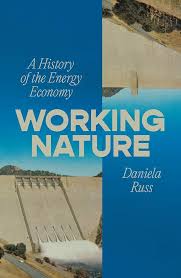
Verso, London, 2026. 240 pp., £16.99 pb
ISBN 9781804298978
Reviewed by Andrzej Frelek
The concept of energy is omnipresent in theoretical writing on the relationship between society and nature. Historically, for some time it even served as the primary means of approaching the problem in economic theory, leading one of the pioneers of ecological economics, Nicholas Georgescu-Roegen, to critique the energy analysis school for its blindness to the limits imposed by the materiality of nature (Georgescu-Roegen 1979). Georgescu-Roegen put forward a pioneering critique of the energy dogma, arguing that human society should learn to live within the boundaries set forth by the natural environment’s ability to regenerate itself. But for all his focus on the concept of energy, he did not commit to the dialectical movement of interrogating its social roots – of attempting to understand it as a reified product of ‘mental, social, and cultural forms […] contain[ing] an experience of nature’ mediated by history (9).
This is the task Daniela Russ set for herself in writing Working Nature, ‘a materialist history of the energy economy’ seeking to ‘understand the concept of energy, the idea of nature’s capacity to perform work, in its relation to production’. Russ’ book demonstrates how this concept arose in the context of a specific period of the capitalist mode of production as a historically specific understanding of nature, as well as how it came to inveigh on the organization of future social and society-nature relations. She takes methodologically after the Frankfurt School, seeking to investigate not only how concepts carry past social experience within them, but also the ways in which ‘the concept becomes objectified, embodied in resources, commodities, machinery, and measuring devices’ – in other words, how the ideal and the material develop historically in tandem (10).
Two such figures are central to the book. Taking after Theodor W. Adorno, Russ shows energy as something objective and objectified, yet also a historically produced concept describing a particular experience of nature, leaving behind an unassimilated remainder – the trace of object’s non-identity with the concept, visible where nature resists human apprehension. To follow the impulse of negation in a work like Working Nature thus means to seek the ‘traces of resistance, as they suggest possible alternative forms of humanity’s relation to nature’ (26). The other debt is to the ‘historical-materialist epistemology’ method pioneered by Alfred Sohn-Rethel’s Intellectual and Manual Labour (2021) (22). Similarly to Sohn-Rethel, Russ carefully traces the scientific development of the studied concept and its objectification in technology, always in connection with social systems and nature-society relations. It is this close investigation of the concrete that allows Russ to demonstrate that the ‘entwined history of the energy economy’ is a history of ‘the becoming of the concept and the thing’ – energy as a reified ‘historically particular category’ objectified in concrete objects (13).
The beginning of the book retraces the developments in natural science and philosophy in the nineteenth and twentieth century which produced the modern idea of energy. Before the industrial revolution, the work of nature was thought of in terms of natural forces, an ‘ahistorical principle conditioning human practice’. Natural forces were viewed as qualitative, particular and irreducible to human apprehension. Energy, on the other hand, conceptualized nature as ‘experienced by a sensual, labouring human being’ interacting with industrial machines, where nature’s work was reduced to a quantitative abstraction (30). There is a temporal and conceptual closeness and intimacy between abstract labour and energy here – if abstract labour discards labour’s concrete determinations, the ‘concept of energy abstracts from the manifold ways in which nature enters production’ to arrive at ‘a quantified understanding of what remains the same in [them] all’ (28).
The concept itself was a product of the new reign of positivism and empiricism in natural philosophy, which grounded energy as the new fundament of physics. But regardless of claims to scientific radicalism, the new energetics were to become a victim of the ruse of reason. The Neo-Kantians understood energy as an actual ‘quantity emerging from relations among phenomenologically different processes and materials’, something both subjective and objective, a transhistorical foundation of reality experienced by the subject (35). Their empiricism thus gave rise to a new positive system with a first principle from which all else was to be derived, including the organization of society based on the view that ‘energy revealed a natural order that rooted the character of societies as productive organisms’ (47). Later natural philosophers retreated from the ontologism of their earlier peers and critiqued it, viewing energy as ‘a social and historical relation […] the objectification of nature rooted in technology and mathematics’, and science as the symbolic sphere to which this concept should be contained (39). Still, their conceptualization of energy was isolated from the mediation of general social processes.
The Soviet thinker Aleksandr Bogdanov proposed an alternative, seeking ‘to reconcile historical materialism with a theory of knowledge’ and energetics (41). In his view, ‘the production of knowledge was no passive registration of sensations, but an active process of working with nature’ – a historically determined one (42). He claimed that energy is neither purely symbolic, nor natural, but rather a practical relation to nature specific to the industrial society requiring a ‘methodological abstraction’ to put nature to work in production (43). In human capability to transform natural forces into energy, Bogdanov saw a potential for a world-making project – for society’s regulation of natural laws in the cause of building a socialist utopia, a project to which nature would have to conform. While Bogdanov recognized the resistance of nature to human apprehension, he was no Adornian (or Platonovian, as Russ notes) – natures’ resistance was a moment to be overcome, not an insurmountable component of a dialectical subject-object relation. If Bogdanov advanced beyond the Western energetics by historicizing the concept of energy, he still paid heed to an idea of progress predicated on the domination of nature.
Our contemporary situation shares a common root with Bogdanov’s utopianism – even if it seems like a cruel capitalist perversion of it – in this idea progress as progress in the subsumption of nature. Russ describes the history of the energy economy in those terms, arguing that this idea fails to observe that real subsumption of nature cannot ever be real – nature’s resistance to human practice does not ‘vanish but [is] displaced’ (71). The history of the energy economy has seen the emergence of entire epistemic regimes to address problems endlessly arising during the search for maximization of efficiency and profit, in which ‘[i]ndustrial capitalism searches in nature not for outbursts of activity but for a reliable, disciplined labour’ (118). There is something of a repetition compulsion to this history of discipline and resistance, in which ‘the distinction between the abstraction capital seeks to realize and nature’s own particular forms never collapses’ (74). Nature has its auto-telic qualities which do not fully conform to socialization – a feature of it constantly re-repressed by new technical regimes.
Electricity is the highest achievement of this history. As a flexible, transformable and transportable form of nature’s work – a veritable energy commodity – it allowed capital to come to a semblance of an overcoming of the antagonism between nature and society. Both Soviet and Western thinkers produced utopian conceptualizations of electrification, predicated on the idea of freedom from work achieved through the application of nature’s work in industry, hitching up ‘the emancipation of the working class to the exploitation of working nature’ (157). Electrical power became the lifeblood of society, a given on which societies base their growth and reproduction – a motive force towards further, uncontrolled development. If there were hopes for using electrical power to consciously reorganize social life, including nature-society relations, they were drowned under ‘the dominant paradigm’ of electrical ‘socialization through the market’ under monopoly conditions (160).
Russ’s critique of energy is of importance for contemporary debates on the shift towards renewables, showing that it should not be fetishized as in itself indicative of a change in nature-society relations. The role played by energy in our society does not end at how we produce and distribute it – it is mediated by conditions under which this production occurs and its ends. A society which seeks emancipation in the boundless usage of energy does not recognize that ‘[t]he control of nature’s work has in fact increased society’s dependence upon nature’ – that ‘the energy concept expresses the truth that society lives not from its own powers’ (213, 214). A transition to renewables under capitalism might only give rise to new forms of profit-seeking and displace nature’s resistance to a different plane through the intensification of extractivism. We should not deny ‘energy’s progressive aspects’, but neither should we fall for new forms of the energetic fetish (216). Without a conscious reformulation of social and nature-society relations we can only arrive at another fantasy of freedom from nature. We still need to look for new ways of conceptualizing the work of nature and its place in human society, and using the concept of energy critically, we should be looking for transformations giving rise to new concepts, not predicated on a history of domination.
This reviewer has only one criticism of Working Nature to give here, focusing on the reading of Adorno’s The Idea of Natural History proposed by Russ. If, as she claims, ‘nature is the obverse not of society but of history’, it is such only for the thought Adorno attempted to criticize (204). His ‘real intention’ was ‘to dialectically overcome the usual antithesis of nature and history’ (Adorno 1984: 111). He argued against firm, stable distinctions – from his perspective of natural history ‘all being or everything existing is to be grasped as the interweaving of historical and natural being’, visible in transience. When he writes that the ‘natural appears as a sign for history and history […] appears as a sign for nature’, he comes closer to Russ’ argument than she suggests (ibid.: 121). The semblance of the natural in the concept of energy stands for a historically produced meaning of nature, while technological progress as the semblance of the new serves to reproduce the most basic natural principle – that of domination. Moreover, if as Adorno argues, the promise of reconciliation is found where ‘semblance in its being-just-as-it is [Sosein] proves itself to be historically produced’, then the promise in the renewables revolution lies in the recognition of the transient character of fossil capital, which opens up the possibility of a social renegotiation of the meaning of nature-society relations (ibid.: 124). The question remains as to how we can bar the capitalist class from being the one to defines it.
Regardless of any minor quibbles, Working Nature is highly recommended. It is one of those rare books one puts away with the feeling that it cannot be possible that it took so long for someone to write them. It is an important intervention in Marxist and critical theory concerned with nature-society relations, one that takes as its object a concept that is integral to those discussions and has for too long been treated as a natural given. Furthermore, it is timely regarding the ongoing shift towards renewable energy and serves as a profound contribution to critique of green capitalism. Finally, Russ’ work testifies to the continuing relevance of the Frankfurt School, and especially of Adorno, the depth of whose thought on the domination of nature is only beginning to be recognized in our conditions defined by the climate crisis.
18 May 2026
References
- 1974 Energy Analysis and Economic Valuation Southern Economic Journal vol. 45, no. 4, pp. 1023-1058.
- 2021 Intellectual and Manual Labour (Brill: Leiden).
- 1984 The Idea of Natural History telos vol. 1984, no. 60, pp. 111-124.

Comment on this review
No comments
View comments