
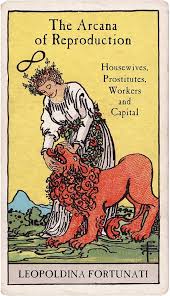
Verso, London, 2025. 352 pp., $29.95 pb
ISBN 9781839767401
Reviewed by Nena Ackerl
Verso has published a new English translation of Leopoldina Fortunati’s seminal contribution to Marxist feminism, The Arcana of Reproduction: Housewives, Prostitutes, Workers and Capital, originally published in 1981 in Italian. In The Arcana, Fortunati puts forth a theory of reproduction with, beyond and against Marx. She argues that Marxists have thus far misunderstood reproduction as an unproductive and natural activity external to capitalist relations, which has led to an incomplete and incorrect analysis of capitalist accumulation and the exclusion of women from class struggle. With The Arcana, Fortunati produced a theoretical complement to the analysis and struggle of the Italian autonomist feminist movement of the time. The new English edition includes a foreword by Silvia Federici, highlighting the continued relevance of Fortunati’s work and a translators’ note by Arlen Austin and Sara Colantuono, offering helpful historical and linguistic orientation. The book closes with an extensive afterword by Fortunati herself, reflecting on the developments of capitalism, specifically the reproductive sphere, since the first publication of The Arcana. While the organisation of reproduction has changed considerably in the last 45 years, The Arcana remains relevant not only as a key contribution to the history of Marxist feminism, but also due to its fecundity for a contemporary analysis of reproduction, and its commitment to an anti-work position and a politics of feminist refusal, which are essential positions against the attachment to wage labour as a means/goal of women’s liberation.
Fortunati defines reproduction as the production and reproduction of labour-power. She posits that the former consists in sexual procreation and the latter in domestic labour, the reproduction of the domestic labourer’s labour power and that of current and future wage labourers, and prostitution/sex work, which contributes to the sexual reproduction of the wage labourer. Throughout the book she reveals several duplicities of capitalist ideology by posing the real against the formal. Firstly, she exposes the illusory division of production and reproduction through the ‘dividing line of value’ (226). Formally, reproduction is defined as the opposite of production, as an unproductive (in terms of value creation), unspecialised, natural activity external to capitalist relations. In reality, she contends, reproduction and production are interdependent spheres, and the former is a productive part of capitalist accumulation just like the latter. Secondly, she argues that formally reproductive labour is a ‘private’ exchange relation between the male wage worker and the female domestic worker, while in reality it is mediated by capital through the wage. She argues that these duplicities are purposeful and necessary mystifications insofar as they conceal the true extant of capitalist exploitation, which does not end at the walls of the factory but extends far into the most intimate parts of life. These duplicities also produce the gendered division of labour particular to capitalism, which only affords men a formal relation to capital, and hence social, political and economic power over women. While she offers an apt criticism of the mystification of reproductive labour, her definition of reproductive labour is too narrow. Rather than only focusing on the reproduction of labour-power, contemporary definitions of reproductive labour tend to include all activities contributing to the reproduction of life, capitalist and non-/anti-capitalist forms of reproduction (Ferguson 2020: 71). Fortunati’s analysis of reproductive labour is also too absolute. She claims that under capitalism the individual is entirely reduced to the commodity of labour-power. While capitalism surely strives towards total dominion, the existence of conscious and unconscious resistance to the reign of capital undermines Fortunati’s claim to totality.
Having revealed that contrary to popular belief, reproduction plays an important role in capitalist accumulation, Fortunati proceeds with analysing how reproduction functions under capitalism. She argues that just like production, reproduction is a process that consists of the consumption of means of production and labour-power to produce commodities and surplus value. In this case, domestic labour-power produces the particular commodity of labour-power and absolute rather than relative surplus value. However, Fortunati acknowledges that although sex work closely resembles wage labour except for its criminalisation and stigmatisation, domestic labour largely functions in opposite ways. While in the sphere of production, labour is waged, reproductive labour needs to be unwaged/indirectly waged for the extraction of surplus value. Additionally, productivity is achieved through underdevelopment rather than development, isolation rather than cooperation/a division of labour, and the maximisation of employment and the mobility of labour. These differences however make reproduction a particular kind of capitalist process rather than non-/extra-capitalist activity. Contrary to many Marxian feminists, Fortunati argues that the labour-power commodity produced through reproduction generates surplus value. However, the exchange value of labour-power is only actualised in the sphere of production where its use value is consumed and its exchange value (the wage) is created, which in turn is consumed in the sphere of reproduction to reproduce its use value. Hence, Fortunati demonstrates that in reality, the spheres of production and reproduction are each others’ conditions and together compose the process of capital accumulation. She thereby fundamentally revises Marx’s theory, who she argues misunderstood the process of capital accumulation and underestimated the rate of exploitation of labour-power by neglecting reproductive labour.
By denaturalising reproductive labour and arguing for its recognition as work, Fortunati not only contributes to feminist critiques of Marxian analysis, but importantly, she provides a systematic argument for the recognition of women as subjects in class struggle, which was much needed at the time of first publication. Today we find ourselves in a different context. While reproduction remains an essential part of capital accumulation, its organisation has changed in ways that contradict or are not captured by Fortunati’s framework. As she acknowledges in the afterword, The Arcana is clearly a product of its time. It was written at a moment when Fordism was still the predominant form of capitalism and the traditional nuclear family with the woman/housewife as its main labourer was the ‘productive nucleus’ of the sphere of reproduction (173). While this family model has certainly not disappeared, it has lost much of its cultural-political power, as family norms have become more flexible and alternative family models, such as the single-parent household and unmarried cohabitation, have become more common. However, the most important developments that necessitate a revision of Fortunati’s theory are the mass entrance of women into wage labour, the increasing redistribution of reproductive work across genders, and the outsourcing of large parts of reproduction from the family to government services, migrant labour and technologies. Thus, contrary to her characterisation in The Arcana, there has been an increasing division of reproductive labour as well as an obfuscation of the distinction between production and reproduction. The commodification of reproduction, for example through paid domestic labourers such as nannies and cleaners, or the outsourcing of domestic labour to restaurants and the entertainment industry, create conditions in which the production and consumption of commodities coincide with the reproduction of labour-power. This response of capital to the transformations in the reproductive sphere has arguably made reproduction even more productive for capital than at the time The Arcana was written. Additionally, the commodification of reproduction is not fully captured by Fortunati’s framework, which focuses on unwaged reproductive labour.
Perhaps more salient, and unrecognised by Fortunati is that The Arcana is also a product of the geographical and social position of its author, that of white Italian (perhaps European and North American) women. While much of Fortunati’s analysis might resonate with the experiences of these women, especially the housewives amongst them, it contradicts the different experiences of other women that engage in waged (reproductive) labour and unwaged reproductive labour, much of whom are migrant women and women of colour. This limitation leads her to present domestic labour as a homogenous category and as generally oppressive and exploitative, which is in conflict with the realities of many women and reproductive labourers of other genders. Very different systems of reproduction can be found in proletarian, migrant, black, indigenous, queer and other communities that are neglected in Fortunati’s analysis. These experiences do not necessarily disprove but rather point to the limitations of Fortunati’s analysis.
In the afterword, Fortunati argues that transformations in reproduction may have increased economic independence for some women, however, they did not liberate women from capitalist exploitation but rather created a double burden, and they have displaced much of domestic labour on under-waged migrant women. Thus, reproduction remains a feminist issue. But, she emphasises, capitalism has begun to care less about the sexual division of reproduction as long as reproductive labour remains predominantly unwaged, unregulated and privatised. While Fortunati refutes these beliefs by demonstrating that under capitalism familial relationships are also relations of production, she does not tend to intimate relationships outside the family form, despite her discussion of sex work which is much less substantial and rigorous than that of domestic labour, and at times outdated. However, her theory of reproduction surely offers arguments and tools that can be used and adapted for the analysis of other relations of reproduction such as non-cohabitational romantic relationships and friendships.
(Re)reading The Arcana today thus motivates a revision and extension of Fortunati’s theory of reproduction based on the historical developments of capitalism she outlines in the afterword and through the perspectives of women, feminised subjects and reproductive labourers that are not represented by the figure of the late twentieth-century, white European housewife and her family. Taking seriously the ambition of social reproduction theory, to engage with systems of domination in their entanglement, means investigating how black, decolonial, queer and trans feminisms expose the limitation of Fortunati’s theory to a certain time, class and geographic-racial location, and offer different accounts of the role of reproduction under capitalism including histories of insurgent reproduction. Because, as Fortunati asserts, capitalism strives to hypostasise its slogan ‘Life is only a function of work’, it is imperative for anti-capitalist struggles to reproduce differently (227). The Arcana remains a key text of the Autonomist feminist tradition that offers important insights and provocations for the radical critique that will enable us to re-organise reproduction for life and against capitalism.
29 April 2026
References
- 2020 Women and Work: Feminism, Labour and Social Reproduction (London: Pluto Press).

Comment on this review
No comments
View comments