
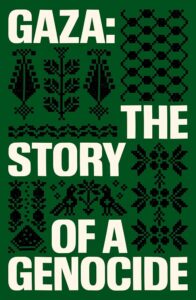
Verso Books, London and New York, 2025. 285 pp., £12.99 pb
ISBN 978-1-83674-224-1
Reviewed by J.J. Headington
I grant you refuge
from hurt and suffering.
With words of sacred scripture
I shield the oranges from the sting of phosphorous
And the shades of cloud from the smog.
I grant you refuge in knowing
that the dust will clear,
and they who fell in love and died together
will one day laugh.
- Excerpted from ‘I Grant You Refuge’, by Hiba Abu Nada, translated by Huda J. Fakhreddine.
This poem was written within the first weeks of the genocide, shortly before Hiba Abu Nada was martyred by an Israeli airstrike on her home in Khan Younis, Gaza, on October 20, 2023. She was thirty-two (see ch.3).
The story of the Gaza genocide is still being written. According to the latest announcement from the Palestinian Ministry of Health in Gaza (at the time of writing, 24 February 2026), at least 72,073 Palestinians have been martyred and 171,749 injured, since October 7, 2023. This official death toll, which rises each day, is undoubtedly a gross underestimation, since it only accounts for people brought to hospitals or recorded dead as a direct result of Israeli military violence. The numbers of indirect fatalities (e.g., from famine, elemental exposure, or lack of access to medical care), together with the dead buried beneath rubble, withheld in detention centres, or otherwise disappeared by the Israeli regime, remain unknown. Employing a quantitative methodology considering the above, a Lancet report from July 2024, argued ‘it is not implausible to estimate that up to 186,000 or even more deaths could be attributable’ to the genocide. A report from July 2025, utilising a similar methodology, estimated the death toll may be as high as 680,000.
These figures present a quantitative picture of the devastating scale of the catastrophe. Yet, statistics cannot calculate the weight of human suffering nor square the total area of annihilation in the Gaza strip. Numbers tend to obscure, rather than represent, individual human lives, and every single Palestinian life lost in the ongoing genocide is a tragedy. In contrast to statistics, stories are a means of sharing human experience. It has been through digital stories – broadcast by Palestinians, themselves, during the ‘world’s first livestreamed genocide’ – that so many of us have witnessed the horror of Israel’s ‘war on life’ (70). In the face of such horror, even the concept of ‘genocide’ seems inadequate in its capacity to signify, to stand in for, that which is unspeakable.
The genre of autobiography, of personal and witness accounts, is an abiding and significant feature of modern Palestinian literature. Remarkably, many diaries and anthologies of first-hand testimonies from the ongoing genocide have been published since 2023. Gaza: The Story of a Genocide differs from these witness accounts through its multi-formal approach, incorporating analysis, reportage, poetry, artworks, graphic novel panels, and interviews, alongside witness accounts from Gaza, and beyond. In this way, the anthology presents a panorama of the genocide from the experiences, expertise, and cultural practices of (predominately) Palestinian contributors from Gaza, the occupied territories, and the international diaspora.
The volume’s opening essays present an outline of the historical-political context of the ongoing genocide. Yara Hawari underscores that the material basis of the US’ support for Israel – the ‘special relationship’ that green-lit the genocide – is predicated upon the longstanding imperialist interests of the US in the Middle East (8, 9). Hawari’s essay traces the lineage of Israeli settler colonialism, from Herzl to Netanyahu, to stress that the genocide, and relentless ethnic cleansing of occupied Palestine, is ‘not an aberration but a continuation of a project that began over a century ago’ (11).
The racist-supremacist ideology of Zionism is dissected in Mary Turfah’s analysis of Israeli society through its junior school textbooks, newspaper articles, academic texts, historical documents, recorded speech (from children in the street to members of parliament in the Knesset), and a typology of the disturbing, viral social media posts shared by IDF soldiers in Gaza. Zionism is shown to have made Israel a psychologically ‘sick society’, in which Jewish citizens ‘learn to see the Palestinian through the scope of a gun’ (54).
Mariam Barghouti offers a view from the occupied West Bank, where she lives. Her focus is on the three years that preceded October 7, that ‘laid the groundwork for Israel’s ongoing campaign of ravaging Gaza and beyond’ (59). These years witnessed new phases of settler-colonial expansion, annexation, and intensified ethnic cleansing; a Gaza offensive; rising cases of administrative detention and extra-judicial killings; drone strikes, air raids, and the testing of new weapons in the occupied West Bank, such as the Elbit Systems’ quadcopter, later used in Gaza (59-65). In this period, the shooting and killing of Palestinians in the occupied territories had become (and indeed, is still) an increasingly common feature of daily life: they were ‘shot at checkpoints, while driving, while playing, while praying’ (66). As Barghouti underscores, ‘even before the genocide, the first half of 2023 became the deadliest period for Palestinians since the UN began recording fatalities in 2005’, including ‘unprecedented numbers of children’ (ibid.). As October 7 unfolded, ‘we watched in paralysis’, Barghouti writes (67). ‘We knew what would come—because it had already come for us’ (ibid.).
Operation al-Asqa Flood, the Hamas-led attack on October 7, 2023, is situated by Tareq Baconi within the history of Palestinian resistance and broader anti-colonial struggles. The attack, in which more than 1,200 people were killed, is viewed as ‘an unprecedented and bloody display of anti-colonial violence’, that ‘can be read only as a response to Israel’s relentless provocation of occupying another people, besieging them, and denying their freedom and right to self-determination for more than seventy-five years’ (16).
Israel’s response was genocidal from the outset. As Laila Al-Arian writes, Israel turned Gaza into a ‘killing cage, where every Palestinian … was considered an enemy, a legitimate target for slaughter’ (70). Al-Arian documents the multifarious ways Israel has targeted civilians since October 7, and simultaneously ‘destroyed everything that gives and sustains life’:
universities, schools, mosques, churches, bakeries, hospitals and homes, so many homes. They attacked water stations, fishing boats, aid convoys, children getting water, adults lining up for flour, people burying their dead, grandmothers waving white flags. They sniped children in the head and heart and executed men point blank in front of their wives and children. They didn’t even leave the dead in peace, as they bulldozed over graveyards and dug up bodies—repeatedly.’ (ibid.)
Al-Arian also draws attention to the acronym WCNSF: Wounded Child No Surviving Family (78). This acronym, unique to Gaza, has been used by health workers to treat and safeguard children since the beginning of the genocide. The adjective ‘wounded’ is meant to imply physical wounds; however, one cannot help but think of the unimaginable mental and emotional scars these children bear.
UNICEF has described Gaza as a ‘graveyard for children’. Eman Basher recovers the memory of some of these children from the obscurity of statistics, recalling her life as a teacher in a school for girls in Beit Hanoun (ch.8). Basher remembers her former students as ‘young women whose lives were already laced with feminist resistance’, who ‘found power in words’, and ‘wrote stories in which women were heroes and poems that raged against injustice’ (108). She vividly shares the names and personalities of some of these young women, stolen by the genocide, in such a way one can picture them. Young women like Jenan Al-Masri, ‘a quiet yet brilliant presence’, whose ‘shy smile reveal[ed] her pride when others clapped for her’ (111-13). Jenan had been chosen to deliver a speech on peace but was killed by an Israeli airstrike before she could ‘speak [it] to the world’ (111). As Basher writes, ‘Nothing prepares a teacher to attend the funerals of her students, one after another’ (114). ‘What could they have become if the world had cared enough to protect their right to dream?’ (113).
Susan Abulhawa draws attention to the annihilistic drive of colonialism, that subjugates, exploits, displaces, and destroys all forms of life – together with the earth, itself – for its own ends (ch.13). Her essay details Israel’s extermination of non-human life, habitats, and biodiversity in the Gaza strip. Although the full scale of this ecocide remains unknown, with the obliteration of the Wadi Gaza wetlands, a key resting place for millions of migrating birds, ‘it is estimated that approximately 250 species of birds will become extinct because of Israel’s genocide in Gaza’ (164).
Ecocide is also the subject of Nina Lakhani’s chapter, that documents Israel’s environmental devastation of the Gaza strip and the multiple ways it has weaponised food and water (ch.9). Insightful parallels are drawn between Israel and Guatemala through their use of scorched-earth tactics to commit genocide and seek to permanently sever indigenous populations from their lands (131-33). In the following chapter, Noor Alyacoubi shares her experience of surviving the siege and famine in Gaza (ch.10). She describes the everyday necessity of searching for and rationing food and water; feeling hunger and thirst; dreaming of bread; and the ‘absurd[ity] that a bag of flour has become [her] greatest comfort’ (135-43). She also tenderly recounts her experience breastfeeding her first child, Lya, under such apocalyptic conditions (144-47).
Malaka Shwaikh exposes the extreme violence, torture, abuse, and murder that is permitted within the walls of Israeli prisons (ch.15). Shwaikh stresses that this ‘permissibility of violence’ is sanctioned by an occupying power that views Palestinians as ‘homini sacri—lives deemed expendable’ (195). Mosab Abu Toha’s essay on being held within an Israeli military detention centre, lays bare the brutality of these hell-like spaces (ch.7). The essay is written in bodily, affective prose, which starkly expresses the physical, psychological, and emotional pain he experienced.
With the turn of each page, this anthology presents a kaleidoscope of horrors. How could it be otherwise? Yet, these pages also contain moments of joy, hope, and love. We share Abu Toha’s joy when he is released from detention, and when in search of his family, he suddenly hears his daughter exclaim ‘Daddy!’ (100). Alaycoubi ‘cling[s] to the hope that someday, her [daughter, Lya’s] world will be full of colors and flavors again’; she ‘dream[s] of her tasting her first bite of something sweet, of her growing strong and healthy in a life beyond war and scarcity’ (147). And Yara Eid’s afterword highlights how ‘in Gaza, love can be felt everywhere, even amid genocide’ (271):
If not for the love of our land and the Palestinians it belongs to, how else would we still be alive? Why else would we be fighting to free it? (274).
Gaza: The Story of a Genocide is a vital anthology that bears witness to the barbarity of the Israeli regime and the enduring sumud (steadfastness) of the Palestinian people. The book is a significant contribution to Palestinian literature in the anglosphere. Its editors are to be commended for collecting and curating so many valuable voices within one volume, under the most trying of circumstances.
As a minor point of criticism, it would have been useful to know the date by which each contribution was composed. Each represents a captured moment, a response, an event in-itself, within the historical time of the genocide. Knowing their dates of composition would have enabled the reader to situate them within their specific historical contexts. But of course, this omission does not diminish the book in any way. This review is limited inasmuch as it is unable to include, and do justice, to all the contributions in the anthology. The book deserves a wide readership, but it also demands more of the reader than reading. In the volume’s introduction, Abu Toha questions: ‘Why do we write? Why do we share stories?’ (1). These universal questions have become instilled with extreme urgency for Gaza’s storytellers. With them, it is to be hoped that readers of this anthology will be moved to act, however they can, to bring an end to the genocide, support its survivors, and fight for the liberation of a free Palestine.
23 March 2026

Comment on this review
No comments
View comments