
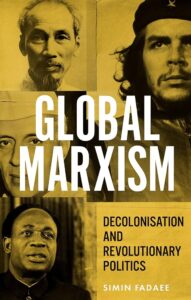
Manchester University Press, Manchester, 2024. 288 pp., £19.99 pb
ISBN 9781526177988
Reviewed by Sanja Petkovska
Prepared by Senior Lecturer in Sociology at the University of Manchester Simin Fadaee, Global Marxism: Decolonisation and Revolutionary Politics challenges the actual understanding held by most postcolonial and decolonial scholars of Marxism as Eurocentric and relevant only to the Global North. Fadaee’s educational background looks quite impressive and seems more than helpful in dealing with the topic: she has been educated in Iran (University of Tehran), India (Jawaharlal Nehru University), South Africa (University of KwaZulu-Natal) and Germany (University of Freiburg and Humboldt University of Berlin). Her current research focuses on political sociology, social movements, revolutions and social justice.
The book’s main argument challenges the claim about the Eurocentrism of Marxism by pointing to the fact that it has influenced the most important leaders of the anti-colonial and decolonial movement worldwide. While decolonial revisionism points to the alleged epistemic incomprehensiveness of Marxist theory for the global South, for not taking outside Europe perspectives equally into account, Fadaee demonstrates that at a peak of the power of Marxism as a doctrine of radical social change, numerous leaders of anti-colonial struggle readily accepted and adopted this theory and political doctrine to local needs and struggles. The conceptualisation of social inequalities as given in Marxism and the ideas of how conflicts among classes might become resolved, resonated equally powerfully almost everywhere worldwide. The book offers an overview of the most important figures who did not have a problem with the origin or the white skin of the two most prominent Marxist scholars, Marx and Engels, as some of the contemporary scholars do.
The structure of the content of the book is based on an overview of the biographies and scholarly work which adapted Marxism, and follows political engagement of nine crucial figures of the anti-colonial struggles of the Global South. Reading through these biographies, the reader receives an informative overview of the background of selected thinkers and political leaders, starting from the way they became connected to the Marxist ideas, and finishing with teachings and the practice of these ideas in their context, ending with how these figures ended their career and life. In certain cases, such endings have been tragic, with consequences for how their legacy is represented today. The methodology of this analysis based on the comparative biographies of the people working under the Marxist influence of anti-colonial politicians demonstrates the extent to which Marxism became a global political power in the postwar period. The list of nine figures important for a Global South comprises Hồ Chí Minh, Kwame Nkrumah, Ali Shariati, Subcomandante Marcos, Jawaharlal Nehru, Mao Zedong, Amílcar Cabral, Franz Fanon and Ernesto Che Guevara. All the leaders of the struggles of decolonisation and anti-imperialism are portrayed through a biographical model and estimation of their intellectual and political achievements in terms of the international fight for social justice and liberation of former colonies. Their examples clearly show that as a social doctrine, Marxism is applicable everywhere, despite the need for making adaptations. In some cases, the modifications of Marxist doctrine made however are not consistent and easily compatible with Marxism itself, but this does not challenge its main ideas and the quest for a more equal and just society, still making the connection meaningful and possible.
There are numerous interesting details to be noticed from the biographical overview of the life and career paths of the leading Marxist decolonial actors and their adaptations of Marxism into the doctrine and the liberation politics of the different countries of the Global South in places and contexts such as China, Vietnam, India, Cuba, Mexico, etc. The undeniable value of the book is in providing this overview of the undeniable and exceptional global influence of Marxism, which inspired so many rebellious movements and struggles for social justice and the overthrow of the occupation of the colonial powers. Despite noting some of the weaknesses of Marx’s work, here also the ‘historical and epistemological realities within which he lived’, acknowledged as Eurocentric, is understood mainly in terms of ‘the lack of access to sources that would have helped him develop a nuanced understanding of non-European and non-capitalist societies’ (6). There is thus reason why Marx underestimated racial relations as a part of capitalist relations. Whatever the real reason, the book demonstrates that this did not obstruct devoted individuals from inscribing their causes and reasons into the Marxist approach and using it as a means to interpret various subjugated positions in the world: national, rural, religious, etc. Marxism provided a guide for action and a framework for revolutionary politics across the world, and therefore the clash between his writings and epistemologies of the Global South might not be so irresolvable as many postcolonial and decolonial thinkers present it today.
Most of the biographies are given simple linear overviews, starting with the place and context of birth, continuing with educational circumstances, discovering Marxist scholarship and working on the ways to implement it within local circumstances formulated as a ‘revolutionary path’, developing their political doctrine of liberation and anti-imperial and anti-colonial approach, most commonly finishing with some input on the contemporary legacy of the people who have contributed to the transformation of the power relations among the Global North and Global South. Among their biographies are equally present figures from the poor and the upper classes. The most interesting aspect of these different pathways is the varieties of the combination of Marxist doctrine with some others like Chinese traditional thought, national liberation, peasantry, etc. For contemporary thinkers, the question of why contemporary thinkers and scholars see Marxism as much more racially exclusive than it was the case with all the postwar Global South leaders might be one of the most crucial ones to address here.
One of the insights while reading the introduction is the given argument through the lenses of intersectional perspective and the fact that in Marxist analyses class remains a dominant factor. In the author’s consideration of this point, only race and gender have some relevance, and the analysis is fallacious since the gender perspective could have been more accentuated, while class is hardly mentioned. The fact that space dedicated to race is disproportionately larger than that dedicated to gender is interesting. The problem of all the included male leaders is simply because all of the prominent women were acting in the background. This signifies the most important structural inequality in contemporary societies, not only their visibility, which signifies something else. This fact is noted but not analysed in more detail. Therefore, the introduction demonstrates a quite contemporary manner of representing social inequalities, where accent is placed on the one which is, outside of relations between real colonizers and colonized, the most problematic inequality to grasp and analyse since it is mainly biological and not always easily and clearly transferable to social relations. Despite the fact that the motive of conjoining Marxist debates to those on decolonisation sounds like a great idea and reflects some of the concrete efforts recently made in this direction, there is a bit of oversight on the incommensurability between the two in terms of all of the layers of the complexity of theoretical and analytical reductions in the huge historical gap over the last two centuries, especially in the domain of understanding inequalities and searching for the means of social justice. Even the authors quoted in the introductory chapter demonstrate an obvious focus on decolonial readings of Marxism, which are in themselves a problem and already reduced and decentred from original Marxist assumptions as such.
Despite a strong reason to assemble leaders influenced by Marxism together, it might be legitimately wondered to what extent observing the prominent figures and their revolutionary pathways tells us about the reception of Marxism in certain countries and continents. Too little self-criticism and reflection has been given to this problem. There could also be a way of understanding the influence of Marxism through many other units of analysis, such as leftist parties or trade unions, labour struggles and strikes outside the European continent. How Marxism influenced the relations of production outside the European context, for example, might be a very important way to understand how it affected structural struggles as well. Thus, the question is not just why only nine men have been selected for this analysis, but as much as why single personalities, who happened to be the main doctrinal and political leaders in their countries, were selected. If considering some of the basic assumptions of Marxist theory, this is above all a much more postcolonial and decolonial way of thinking and there comes the need of better connecting Marxism and decolonial thought, but also to practically demonstrate that it has been accomplished.
Another weak point of the book is the too simplistic elaboration on the fact that everyone is determined by their own perspective and positionality, while the potential of overcoming such a standpoint is, expectedly, quite limited. The potential of overcoming one’s own perspective particularly, in the historical periods when knowledge about other perspectives is been also limited, is under question. The author seems to acknowledge as much, but still offers a reading of Marxist thought as if the world interacted to it as it does now. It can therefore be asked: is the problem of Eurocentrism the biggest objection from which to defend Marxism? Are we being too limited by our expectations and assumptions while thinking in this way? Could the authors of historical periods and epistemological approaches think otherwise than from their own perspective? Eventually, they might take into account the others, but this might be hard to overcome. The perspective of those historical figures has been Marxist while combining it with other components; for them need to make their own perspective visible might seem unnecessary. We get the final impression that at least in general, the approach of Marxist theory should be represented and recognized in the analysis to a much greater level rather than just declaring what Marxist theory allegedly ignored. The main reason of the anti-colonial and anti-imperial struggles of the Global South and Global East were not only power relations, but above all also the poverty, economic struggles of survival and economic exploitation, and these are not the same things. We do not see much of this present in Global Marxism. Therefore, a similar analysis in the future, if following the advice of Simin Fadaee, should focus much more on wealth and poverty to accompany the ascribed relations of power whose place in the discussion needs to be restored within the debate on the relations between the Global North, Global South and Global East, in order to better combine Marxism and postcolonial and decolonial thought.
12 November 2024

Comment on this review
No comments
View comments